
For battery cells, review the product description for real-world current recommendations, testing notes, and application guidance. Manufacturer maximum ratings should be treated as limits, not the best target for long-term pack health.


Description
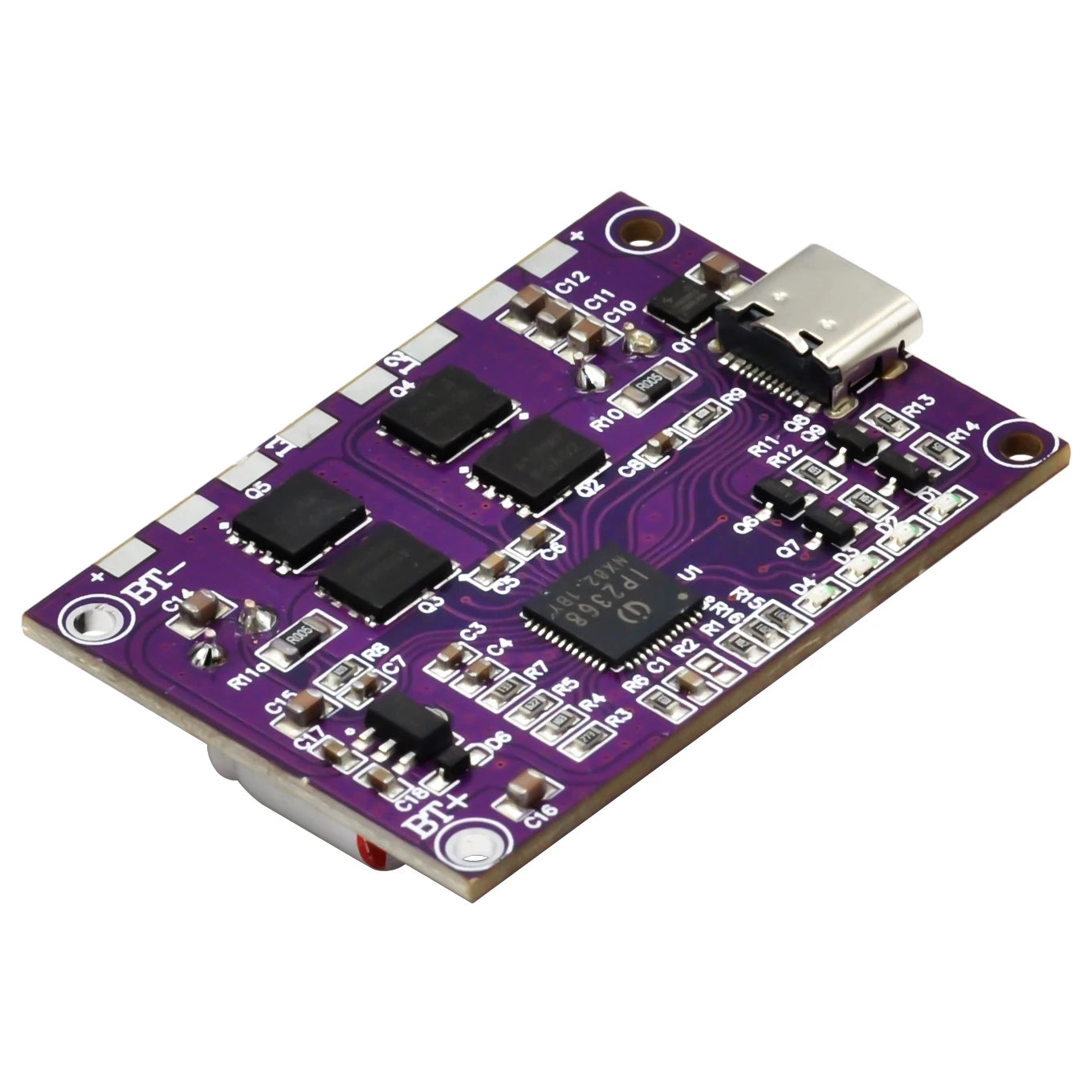
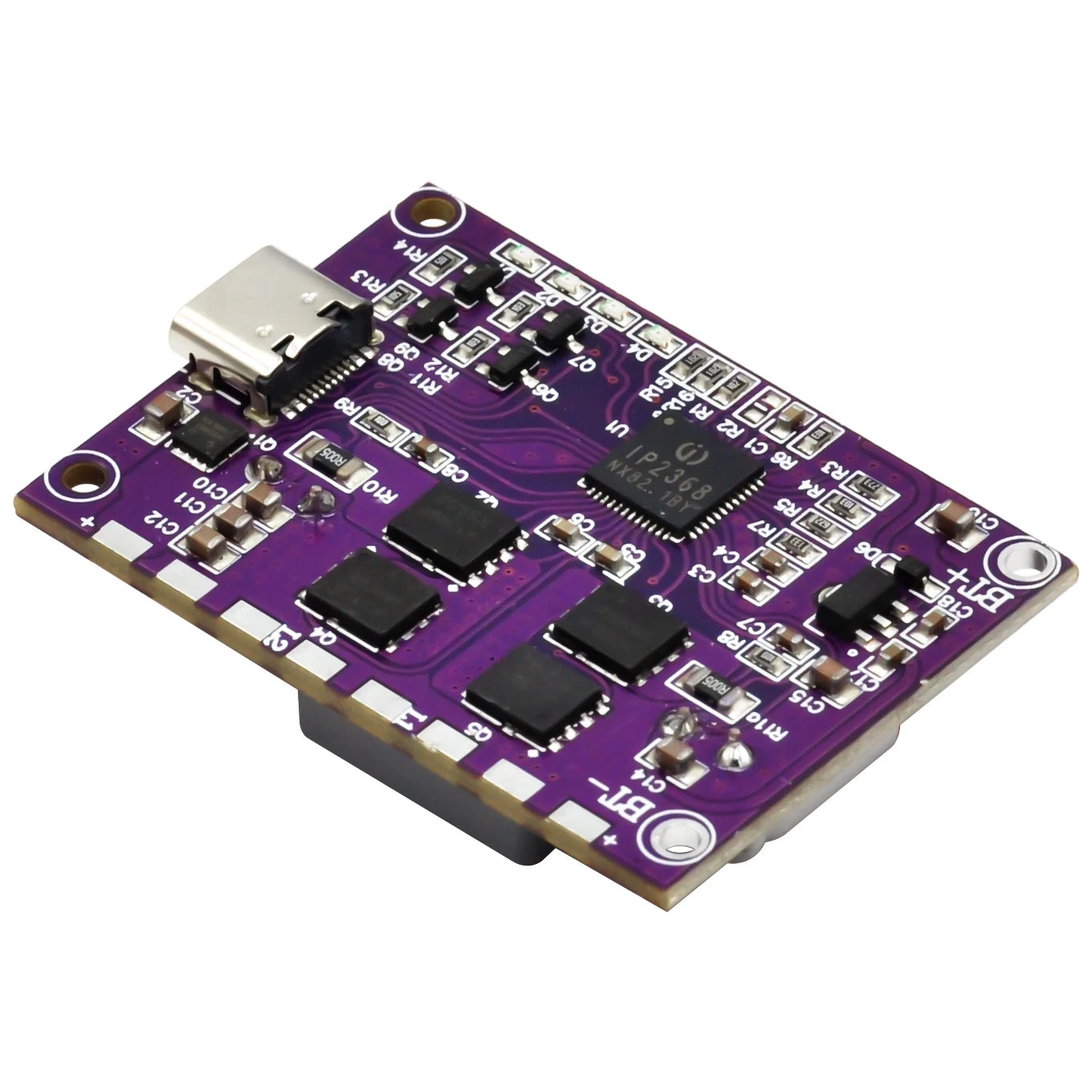
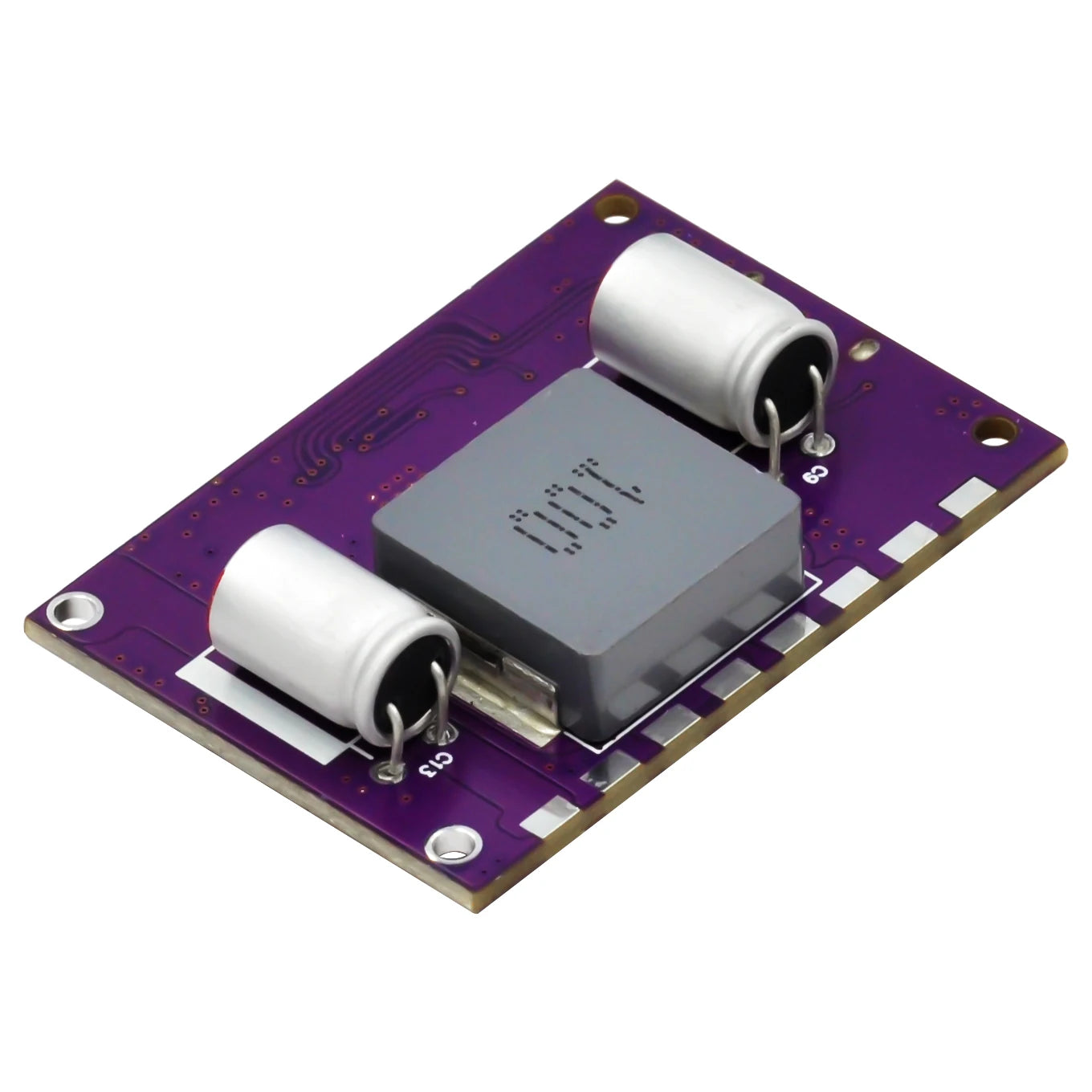
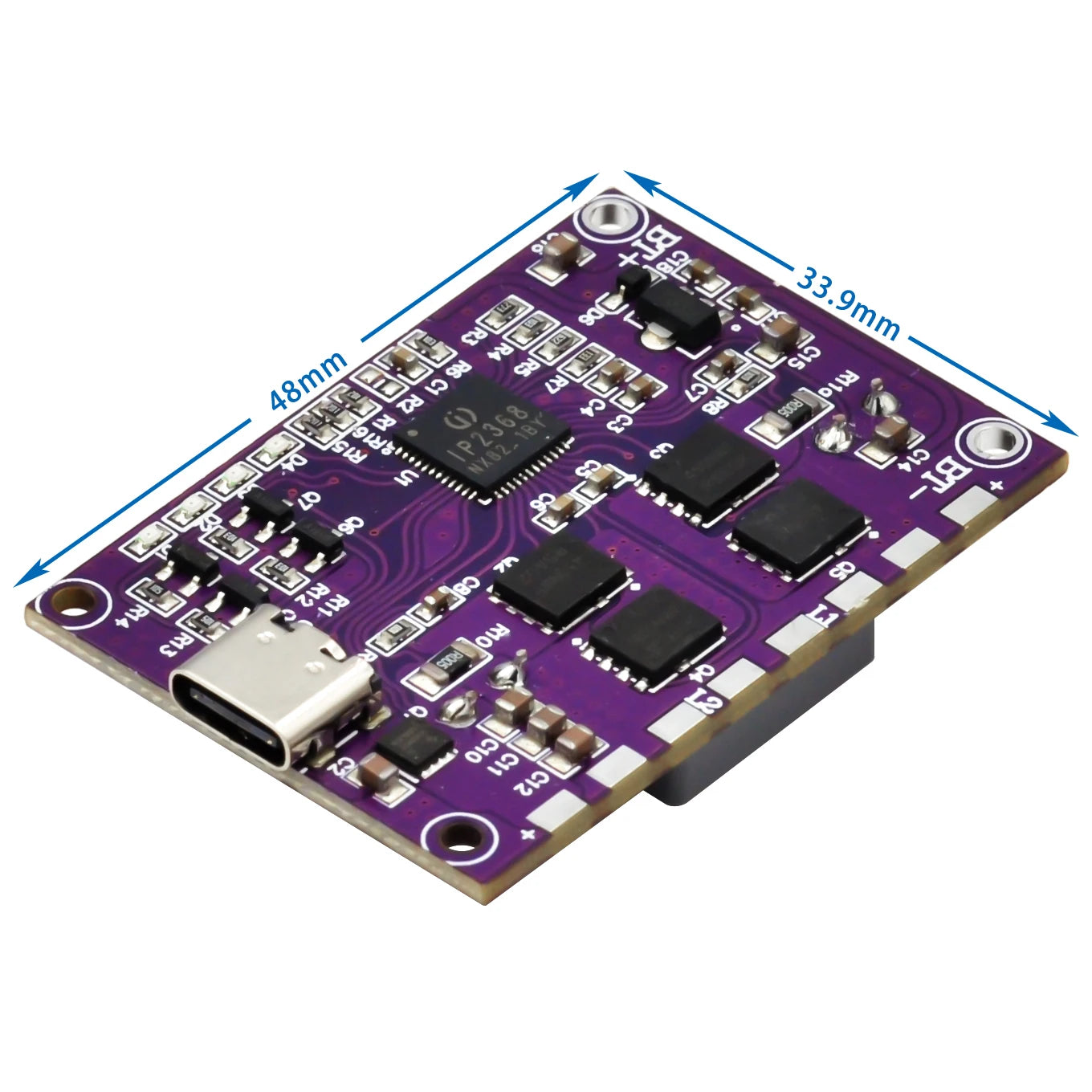
Open-frame bidirectional USB-C power module built around the Injoinic IP2368 controller and supplied for a protected 4-series lithium-ion battery project.
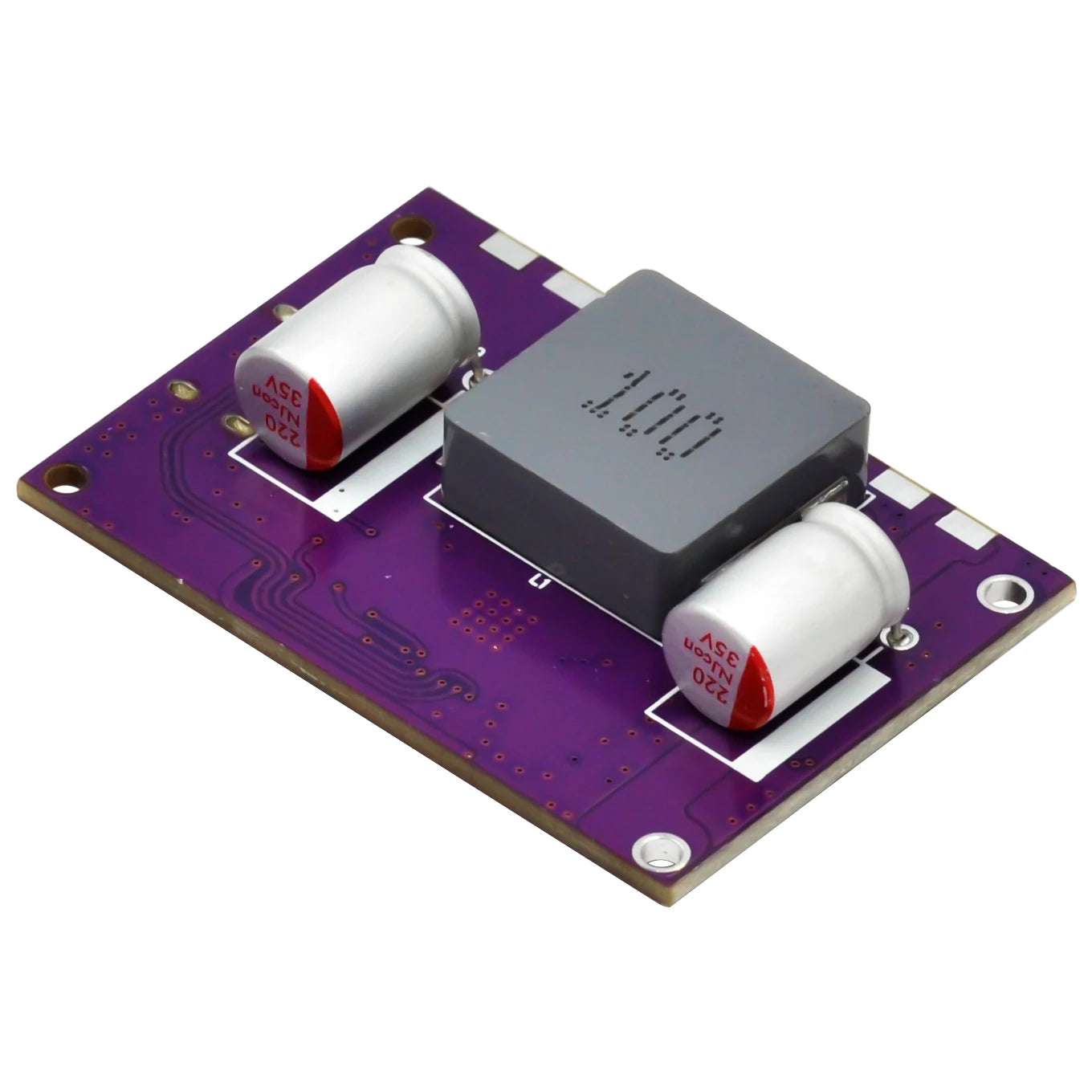
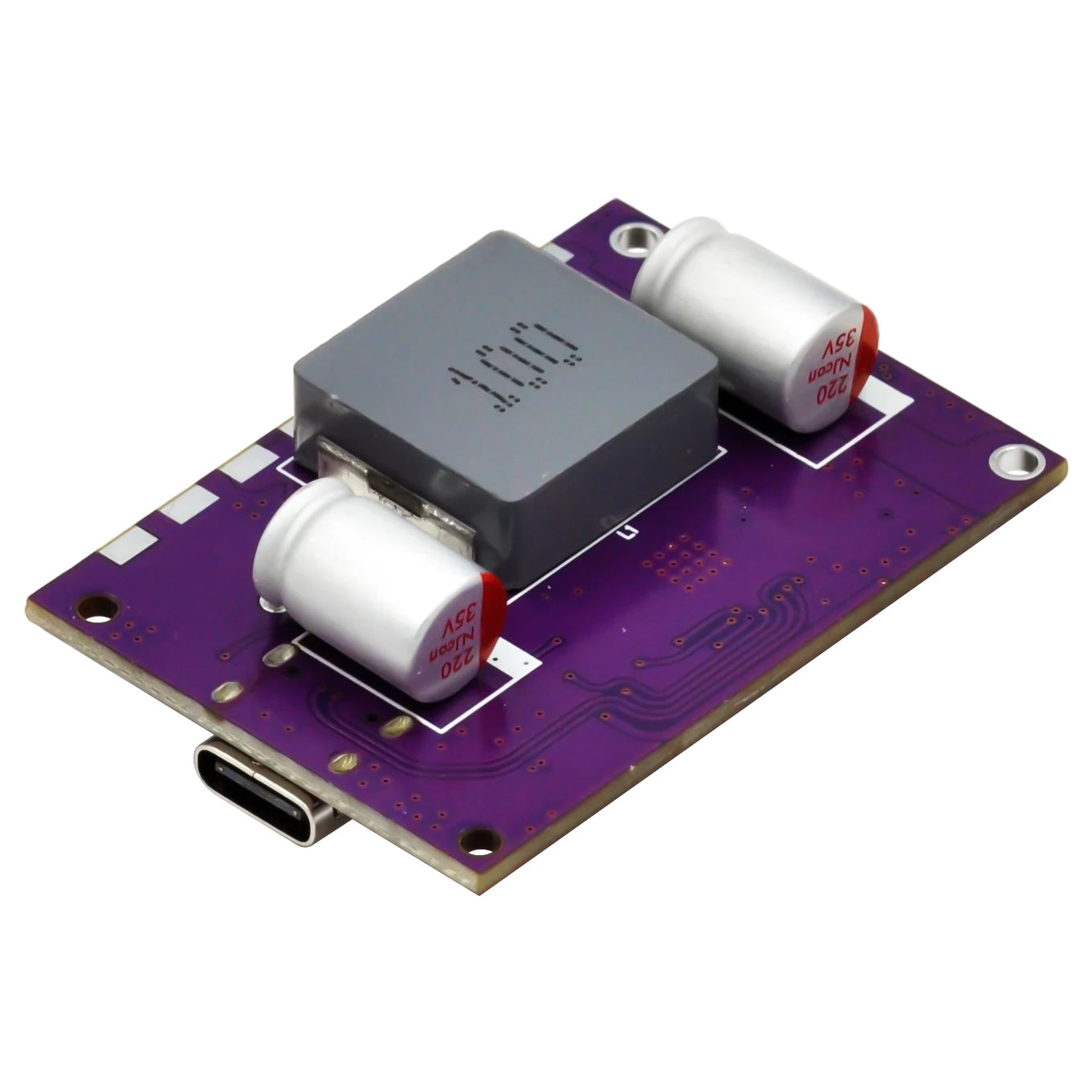
In one direction, a compatible USB-C Power Delivery source can charge the connected pack. In the other, the pack can supply negotiated USB-C power to a compatible load. The synchronous buck-boost stage allows the USB-C port voltage to be regulated above or below pack voltage.
Received board configuration
- Battery configuration: 4S lithium-ion, as ordered from the module seller
- Full-charge target: seller identifies the 4S version as approximately 16.8V; verify the actual cutoff before connecting cells
- Battery connection: large PCB pads marked BT+ and BT−
- USB interface: one bidirectional USB Type-C port
- Board size: approximately 48 × 33.9 mm in the seller drawing
- Construction: bare/open PCB with corner mounting holes
IP2368 controller capabilities
| Power topology | Synchronous bidirectional buck-boost charge/discharge controller |
|---|---|
| Supported series count at IC level | 2S–5S; this assembled board is sold as the 4S version |
| USB-PD support at IC level | PD 2.0 / PD 3.0 with 5V, 9V, 12V, 15V, and 20V PDO capability |
| Battery-side charging ceiling at IC level | Up to 5A, subject to configuration and thermal limits |
| Design power ceiling | Up to 100W when every required condition is met |
These are controller-level capabilities from the current IP2368 V1.41 data sheet. The exact PDOs, current limits, protection thresholds, and continuous power available from this assembled board depend on its IC suffix, resistor configuration, populated support circuitry, battery, BMS, cable, source/load, and cooling.
What “up to 100W” means
100W is a design ceiling—not a guaranteed continuous operating rating. The IP2368 documentation requires detection of a 5A E-marked USB-C cable and an external E-mark circuit to advertise output above 60W. Because that circuit and this board’s complete configuration have not been independently validated by DIY500AMP, treat operation above 60W as unconfirmed until the specific installation is bench-tested.
Available charging power can also be lower than output power. Do not use copied marketplace claims of 10A charging, 18A continuous battery current, or 30A peak current for this module; those values are not established by the current controller data sheet.
Builder setup checklist
- Read the IC marking and verify the installed 4S lithium-ion series-count, chemistry, charge-cutoff, and power-setting components before connection.
- Use matched cells with a correctly specified 4S protection-and-balancing BMS, fuse, adequate conductor size, insulated connections, and strain relief.
- Observe BT+ / BT− polarity. A reverse connection can damage the board or connected equipment.
- Insulate the underside, secure the PCB without stressing components, and provide airflow or other thermal management appropriate to the tested load.
- Use a compatible USB-C PD source/load and a certified cable. Verify negotiated voltage and current with proper test equipment while monitoring board and connector temperature.
- Do not parallel modules for current sharing or advertise the board as a seamless UPS without a separate engineered and validated power-path design.
This board is not a cell-level BMS or balancer. Do not connect it directly to an unprotected 4S cell group. Do not use it with LiFePO4 unless the installed chemistry and charge cutoff have been positively verified.
What is included
One IP2368 4S USB-C module. Battery cells, BMS, fuse, wiring, enclosure, charger, USB-C cable, heatsink, and test equipment are not included.
Download the official Injoinic IP2368 V1.41 data sheet (Chinese PDF)
For experienced electronics and battery builders. Ships from DIY500AMP.COM in Florida when in stock.
Orders ship from Florida when inventory is available. Lithium-ion cells require proper handling, protected packs, correct chargers, and safe storage. Do not solder directly to battery terminals.
Payment and Security
Your payment information is processed securely. We do not store credit card details nor have access to your credit card information.
You may also like
Let customers speak for us
Everything is great 100%recommended fast and
Everything is great 100%recommended fast and professional
Daniel Kammerdiener

Pure Nickel Strip Roll for Battery Spot Welding
One of my cell orders was short one cell
One of my cell orders was short one cell. When I went to send a text to the customer contact (this is rare and awesome way to reach out), the reply on a national holiday came within 15 min. That level of customer service is incredible, like family. I really appreciate that!
Joseph Krienert
DIY500AMP.COM
Wow, these cells are great!
I purchased some of these tabless cells to try on my 1S 3" HD Toothpick drone build, and, albeit a bit heavy for 1S, it flies pretty well. Not a freestyle monster, but an endurance beast with decent send. These cells shrug off the demands of a BETAFPV Matrix HD AIO flight controller/12A ESC and some 1202.5 11000KV motors. I'm getting 15+ minutes of speedy flight time from a single cell trying not to go below 3.2V, and about 20+ minutes cruising. Love these cells and will definitely buy more when time comes, only from DIY500AMP, who are terrific!
VN in AZ

EVE 30PL 18650 3000mAh 60A Battery Cell - Tabless
What customers think about the store
This store specializes in high-performance lithium-ion batteries and accessories, offering exceptional customer service with same-day shipping and fast delivery (typically 2-3 days). Customers consistently praise the owner's knowledge, responsiveness, and comp...
AI-generated from customer reviews.
Batteries Cells Service Shipping