


DIY500AMP Cell Intelligence
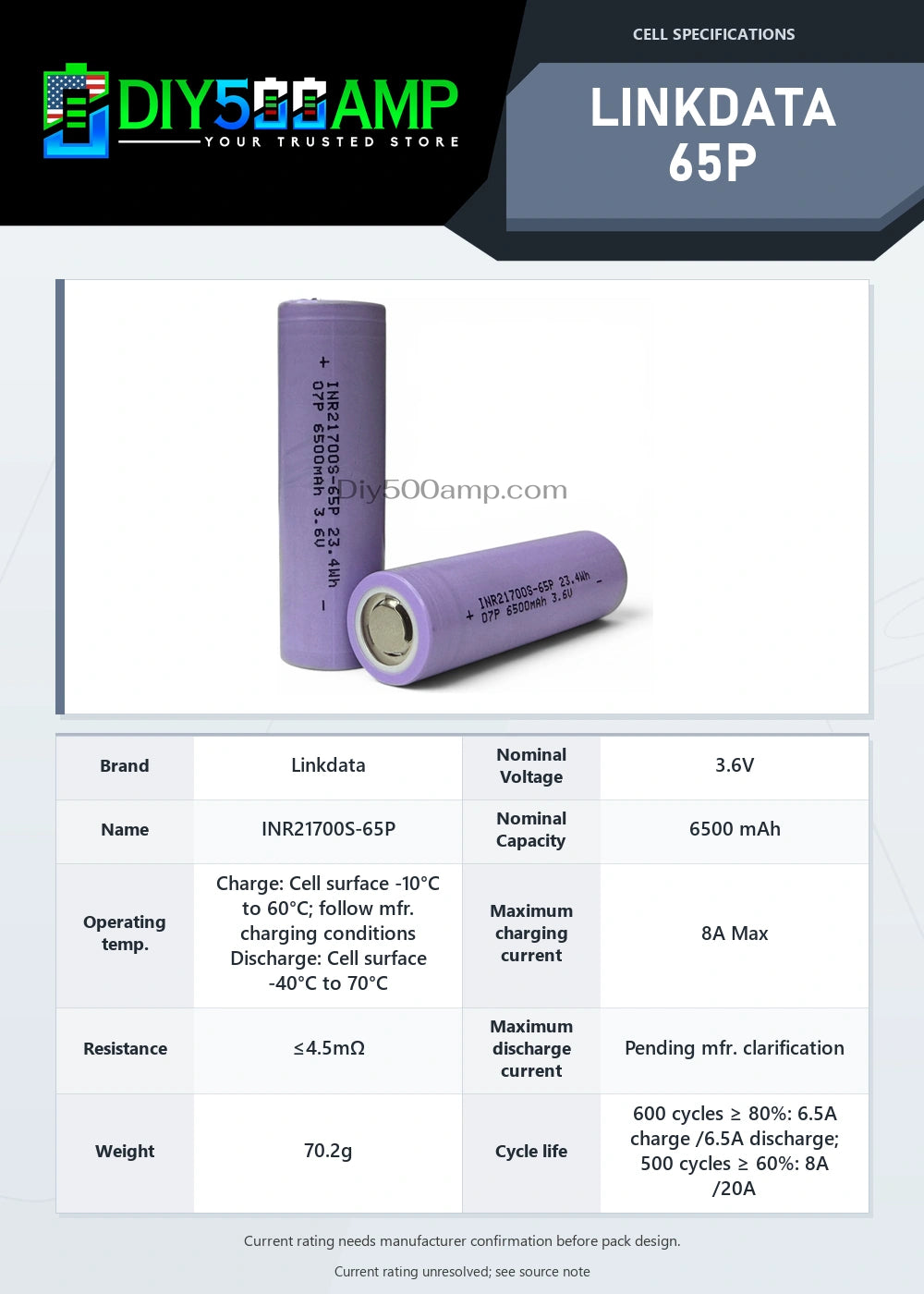
Linkdata 65P
Application selection requires a confirmed manufacturer current rating.
Manufacturer data sheet
Cell at a glance
Current rating unresolved; see source note
Full technical specification
| Store SKU | LKD-65P-21700-B1 |
|---|---|
| Manufacturer / model | Linkdata INR21700S-65P |
| Format / chemistry | 21700 / Li-ion |
| Rated capacity | 6500 mAh (minimum 6370 mAh) |
| Nominal voltage | 3.6V |
| Full-charge voltage | 4.2V |
| Discharge cutoff voltage | 2.5V |
| Standard charge current | 3.25A |
| Maximum charge current | 8A |
| Initial internal resistance | <=4.5 mOhm |
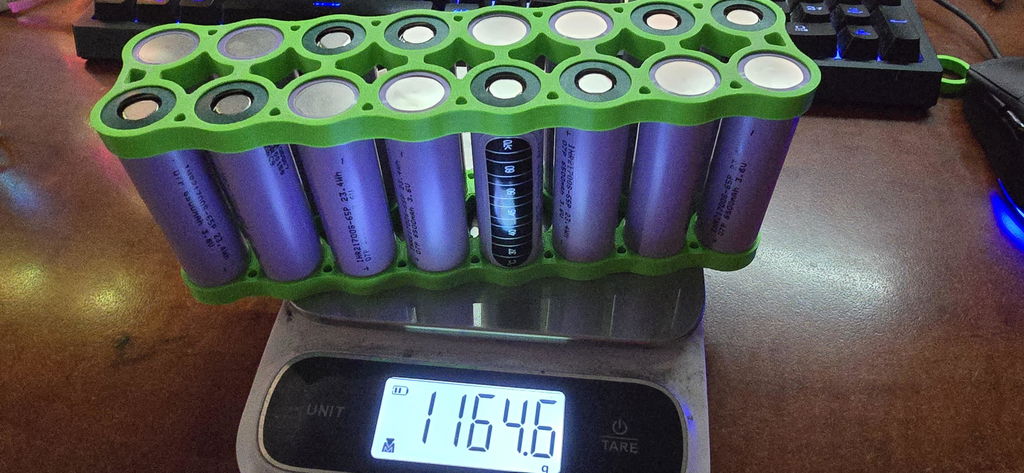
| Weight | 70.2g |
| Dimensions | Diameter 21.35+/-0.15mm; height 70.7+/-0.2mm, with plastic film |
| Charge temperature range | Cell surface -10C to 60C; follow manufacturer charging conditions |
| Discharge temperature range | Cell surface -40C to 70C |
| Cycle-life reference | At 25+/-2C: 600 cycles with >= 80% initial capacity using 6.5A charge /6.5A discharge; 500 cycles with >= 60% using 8A charge /20A discharge. Charge to 4.2V with 0.02C termination; discharge to 2.5V; rest 30 min. This cycle evidence does not resolve the conflicting maximum-current thermal limits. |
| Protection | Unprotected industrial cell. The finished device or battery pack must provide appropriate protection. |
Simple selection guide
Is this the right cell for your build?
Match the cell to the job, then confirm the manufacturer limits for the finished pack.Best match
Application selection requires manufacturer clarification of the conflicting thermal limits.
A better alternative when
Do not size a pack from a current rating whose cutoff conflicts with the stated operating-temperature limit.
Engineering limits
Current limits
Manufacturer continuous-discharge ratings only. Pulse and over-current laboratory values stay on BatteryRealData.The available manufacturer specification gives conflicting thermal limits: its discharge-current row references80C cutoff, but its operating-temperature row limits cell surface to 70C. A verified continuous-current recommendation and pack calculator are withheld until the manufacturer resolves the discrepancy.
Real discharge testing
Tested by BatteryRealData
A manufacturer-compliant test summary is not currently shown for this cell. Review the specification notes above. BatteryRealData provides separate laboratory context.
Only tests inside the matched data sheet continuous-current range are summarized here. BatteryRealData may separately include controlled pulse or over-current research; those laboratory stress tests are not product ratings or operating instructions.
View BatteryRealData laboratory testsRead before purchase and use
Safety warning for lithium-ion battery usage
Customers should understand lithium-ion battery handling and safety before purchase. Lithium-ion cells can cause fire, burns, venting, or explosion if misused, overcharged, shorted, crushed, punctured, overheated, or physically damaged.
Use only with a compatible lithium-ion charger, BMS, or protection circuit designed for the cell voltage, current, and temperature limits. Never leave batteries charging unattended. Charge and store on a fire-resistant surface away from combustible materials.
By purchasing and using lithium-ion cells, the user assumes responsibility for correct handling, storage, charging, pack design, and application suitability.
Important usage guidelines
- Not for use in e-cigarettes, vape devices, or similar devices.
- Always use in a protected battery pack or properly controlled test fixture.
- Do not exceed the data sheet maximum charge voltage.
- Do not discharge below the recommended system cutoff voltage.
- Do not charge or discharge outside the data sheet temperature limits.
- Do not carry loose cells in pockets, bags, or toolboxes where they can contact keys, coins, tools, or other metal objects.
- Store and ship cells in protective cases or insulated packaging.
- Do not use batteries with torn wrappers, missing insulator rings, dents, rust, odor, leakage, deformation, heat damage, or visible damage.
- Do not solder directly onto cell terminals. Use proper spot-welding methods only.
- Do not alter, dismantle, puncture, crush, burn, immerse in liquid, or expose cells to open flame.
- Keep away from children and pets.
Pass all safety information to end users to promote safe handling, correct pack design, and proper use.
Common questions
Linkdata 65P FAQ
Does this cell include built-in protection?
No. It is an unprotected industrial cell. A compatible device or finished pack must provide over-charge, over-discharge, over-current, short-circuit, and thermal protection as required by the application.
Is the maximum current the normal operating target?
No. A manufacturer maximum is a limit under stated conditions, not an automatic long-term design target. Use headroom and validate the finished pack under the actual load, duty cycle, cooling, and temperature limits.
Can I solder directly to the cell?
No. Direct soldering can overheat and damage the cell. Use correctly configured spot welding and suitable interconnect material.
Can I mix this cell with another model or an older batch?
Do not mix different models, ages, capacities, internal-resistance groups, batches, or states of charge in one pack. Build with matched cells and balanced parallel groups.
Can I carry or store the cell loose?
No. Isolate the terminals in a protective case or insulated packaging. Never carry loose cells with keys, coins, tools, or other conductive objects.