


DIY500AMP Cell Intelligence
Linkdata 50T
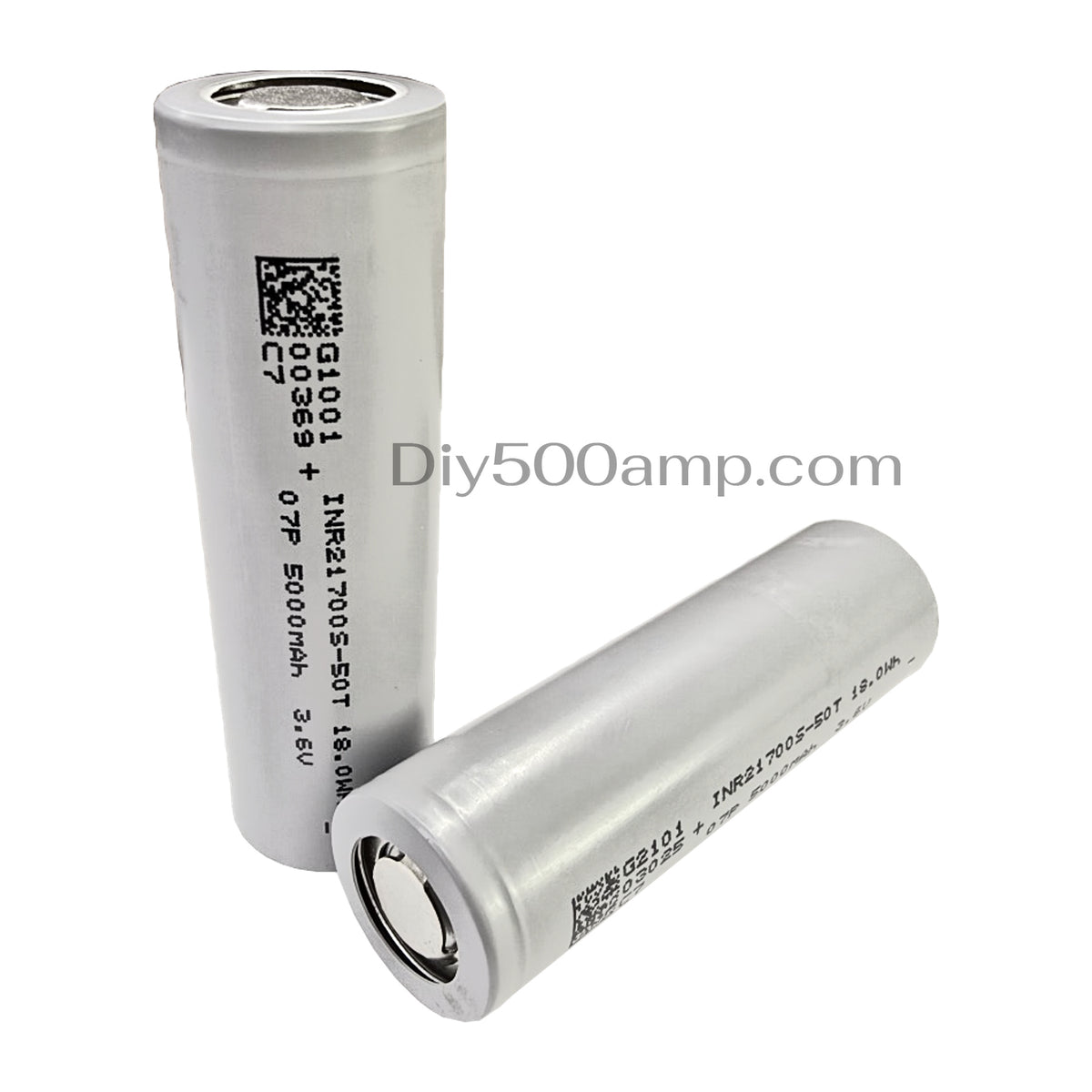
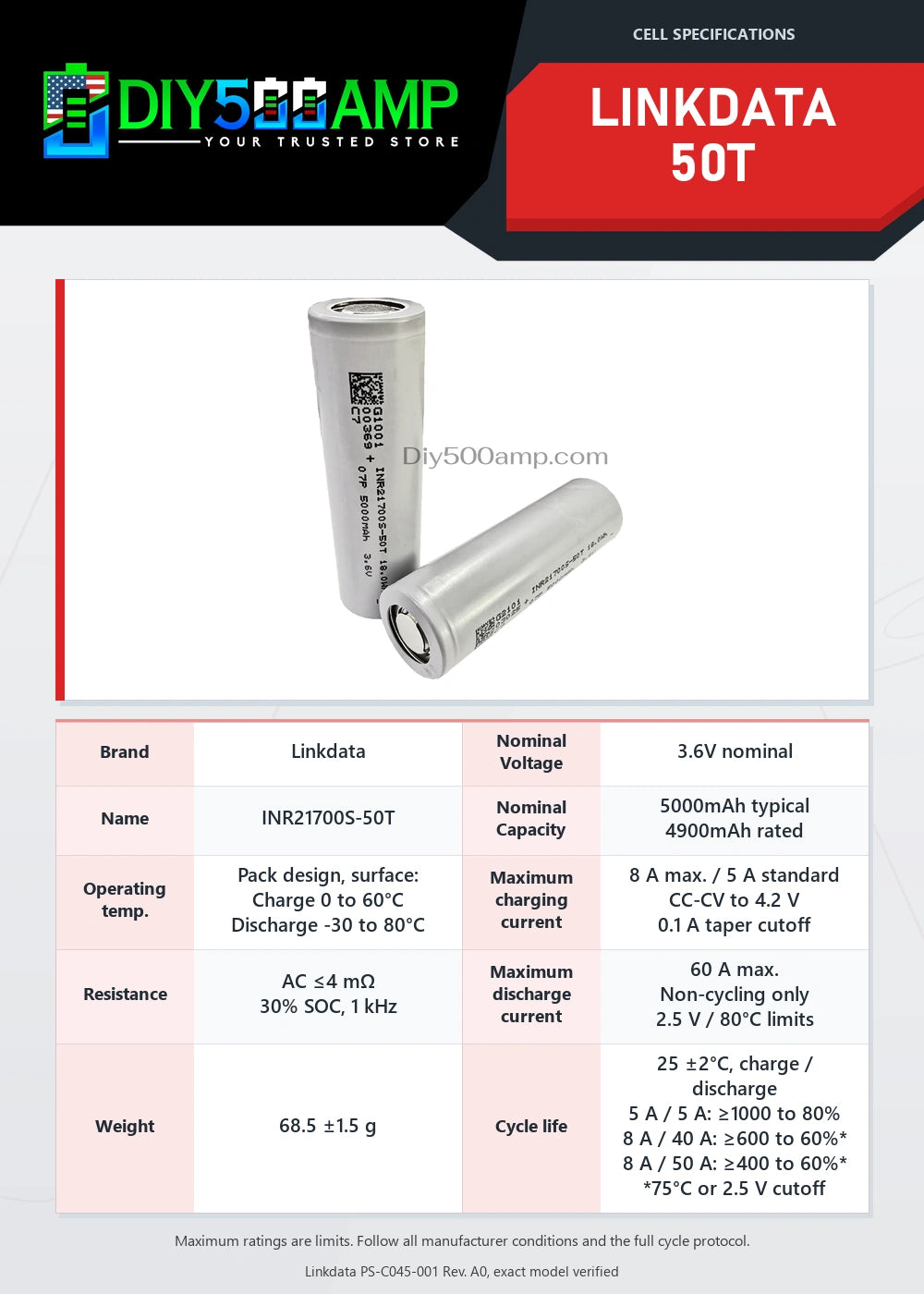
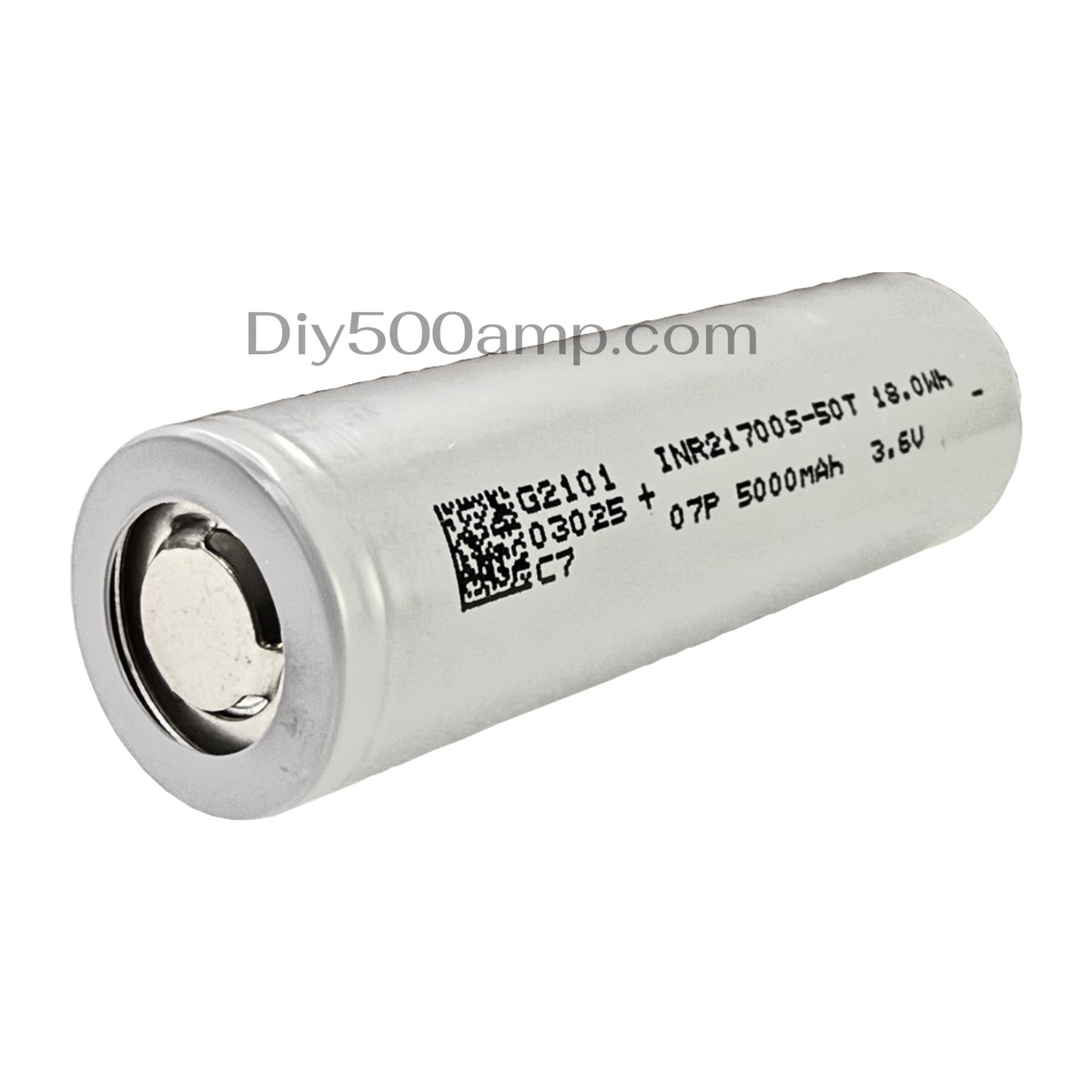
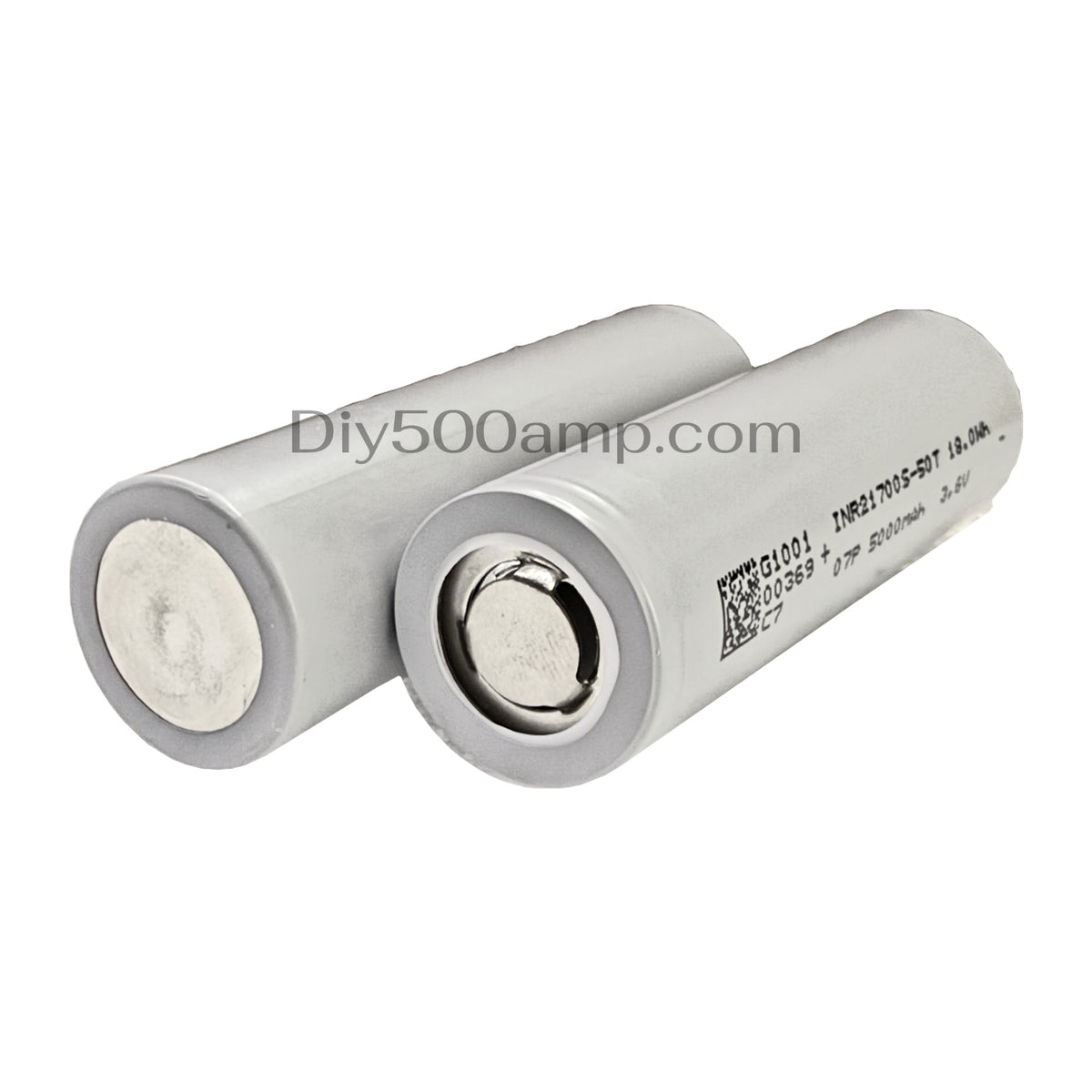
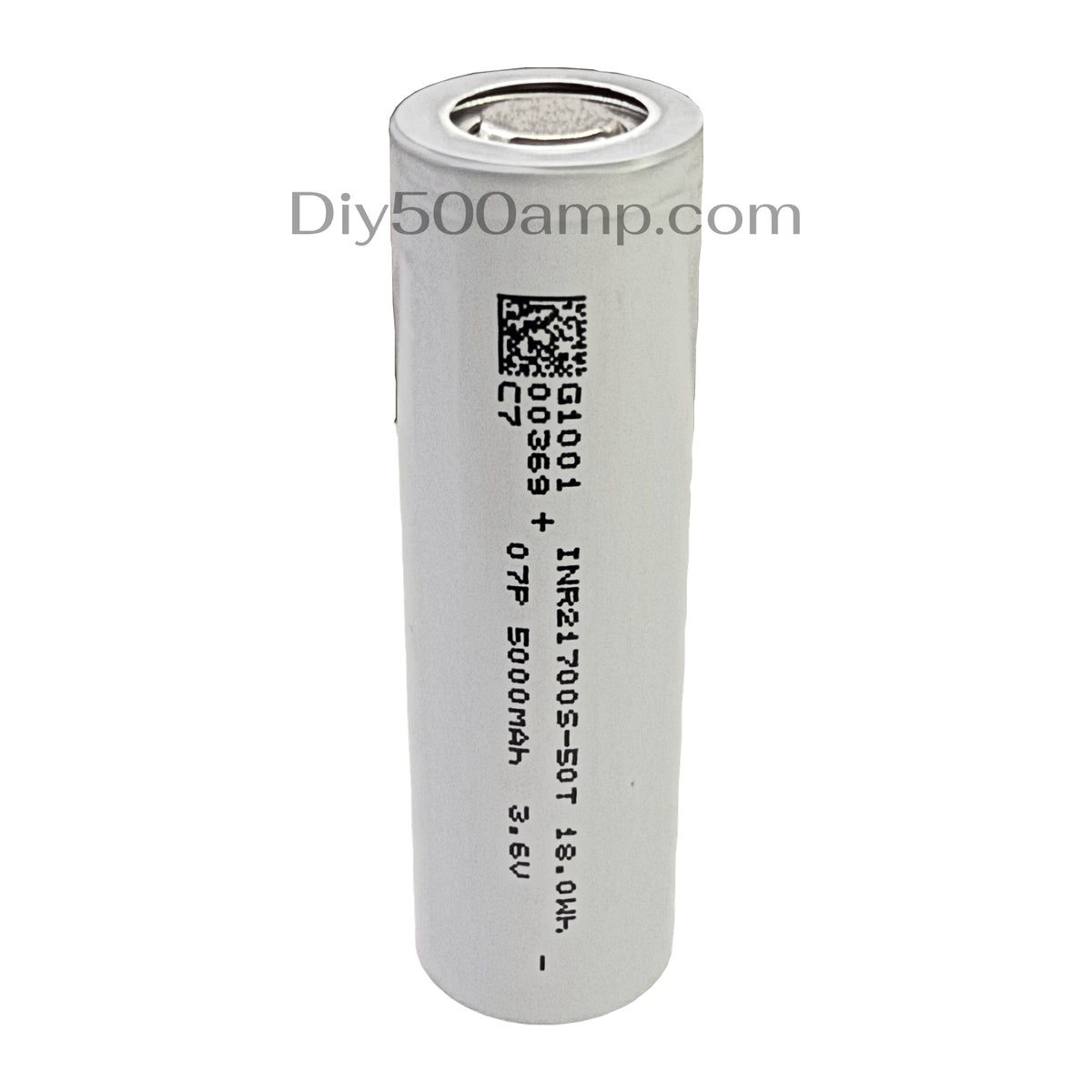
One unprotected 21700 lithium-ion cell. Typical capacity is 5000 mAh and rated capacity is 4900 mAh. The wrapper shows 3.6 V and 18.0 Wh. Linkdata specifies 17.6 Wh on its rated-capacity basis. The maximum continuous discharge of 60 A is limited to non-cycling use. For repeated use, see the manufacturer cycle protocols below.
Checkout shows the shipping options for your destination and quantity. For a shipping quote, contact sales@diy500amp.com.
Manufacturer data sheet
Cell at a glance
Linkdata PS-C045-001 Rev. A0, exact model verified
Full technical specification
| Store SKU | LKD-50T-21700-B1 |
|---|---|
| Manufacturer / model | Linkdata INR21700S-50T |
| Format / chemistry | 21700 / Lithium-ion |
| Rated capacity | 5000 mAh typical (minimum 4900 mAh rated) |
| Nominal voltage | 3.6V |
| Full-charge voltage | 4.2V |
| Discharge cutoff voltage | 2.5V |
| Standard charge current | 5A |
| Maximum charge current | 8A |
| Continuous discharge rating | 60 A maximum, non-cycling only |
| Initial internal resistance | AC <=4 mOhm at 30% SOC and 1 kHz |
| Weight | 68.5 +/-1.5 g, bare cell |
| Dimensions | 21.35 +/-0.15 mm diameter at 30% SOC; 70.7 +/-0.2 mm wrapped shoulder height |
| Charge temperature range | Pack and charger design: 0 to 60 C. Linkdata recommends resuming charge below 45 C. |
| Discharge temperature range | Pack design: -30 to 80 C cell surface. Resume discharge below 60 C. High-rate cycle tests stop at 75 C. |
| Cycle-life reference | At 25 +/-2 C, 5 A charge / 5 A discharge: at least 1,000 cycles to the 80% capacity criterion. With 8 A charge and 40 A discharge: at least 600 cycles to 60%. With 8 A charge and 50 A discharge: at least 400 cycles to 60%. Charge CC-CV to 4.2 V, taper to 0.1 A, then rest 30 minutes. Discharge to 2.5 V; the 40 A and 50 A tests also stop at 75 C. Rest 30 minutes after 5 A discharge, or 60 minutes after high-rate discharge. Linkdata ends each test after two consecutive readings below its threshold. |
| Protection | Unprotected industrial cell. The finished device or battery pack must provide appropriate protection. |
Simple selection guide
Is this the right cell for your build?
Match the cell to the job, then confirm the manufacturer limits for the finished pack.Best match
Professionally engineered packs with voltage, current and cell-surface temperature protection, sized for the actual duty cycle.
A better alternative when
Unprotected single-cell use or a design that needs 60 A repeatedly. The datasheet gives separate cycle-life protocols at 5 A, 40 A and 50 A.
Application guide
Where this cell fits
RC / UAV, power tools, e-bike / mobility, runtime-focused packs
Energy storage and backup systems
Vape and e-cigarette devices
Keep the finished pack within every manufacturer voltage, current, and temperature limit.
Engineering limits
Current limits
Manufacturer continuous-discharge ratings only. Pulse and over-current laboratory values stay on BatteryRealData.Linkdata lists 60 A as a non-cycling maximum. Set pack design current below the cell limit and validate under load. Use a suitable BMS, fusing, insulation, matched parallel groups, balanced current sharing, conductors sized for the load, mechanical restraint and cell-surface temperature monitoring. Stop discharge by 2.5 V or 80 C. Sections 3.15 and 10.1 give different minimum temperatures; the narrower pack-design limits are shown here. Keep both terminals protected during handling and transport.
Show current and runtime examples Optional 1C references and idealized runtime estimates
Current envelope
Relative current values from the matched manufacturer data sheet. Bar length is comparative, not a recommendation.
Current and runtime translation
Idealized constant-current runtime based on nominal capacity. Real packs deliver less because voltage sag, heat, cutoff voltage, and losses matter.
Read before purchase and use
Safety warning for lithium-ion battery usage
Customers should understand lithium-ion battery handling and safety before purchase. Lithium-ion cells can cause fire, burns, venting, or explosion if misused, overcharged, shorted, crushed, punctured, overheated, or physically damaged.
Use only with a compatible lithium-ion charger, BMS, or protection circuit designed for the cell voltage, current, and temperature limits. Never leave batteries charging unattended. Charge and store on a fire-resistant surface away from combustible materials.
By purchasing and using lithium-ion cells, the user assumes responsibility for correct handling, storage, charging, pack design, and application suitability.
Important usage guidelines
- Not for use in e-cigarettes, vape devices, or similar devices.
- Always use in a protected battery pack or properly controlled test fixture.
- Do not exceed the data sheet maximum charge voltage.
- Do not discharge below the recommended system cutoff voltage.
- Do not charge or discharge outside the data sheet temperature limits.
- Do not carry loose cells in pockets, bags, or toolboxes where they can contact keys, coins, tools, or other metal objects.
- Store and ship cells in protective cases or insulated packaging.
- Do not use batteries with torn wrappers, missing insulator rings, dents, rust, odor, leakage, deformation, heat damage, or visible damage.
- Do not solder directly onto cell terminals. Use proper spot-welding methods only.
- Do not alter, dismantle, puncture, crush, burn, immerse in liquid, or expose cells to open flame.
- Keep away from children and pets.
Pass all safety information to end users to promote safe handling, correct pack design, and proper use.
Common questions
Linkdata 50T FAQ
Does this cell include built-in protection?
No. It is an unprotected industrial cell. A compatible device or finished pack must provide over-charge, over-discharge, over-current, short-circuit, and thermal protection as required by the application.
Is the maximum current the normal operating target?
No. A manufacturer maximum is a limit under stated conditions, not an automatic long-term design target. Use headroom and validate the finished pack under the actual load, duty cycle, cooling, and temperature limits.
Can I solder directly to the cell?
No. Direct soldering can overheat and damage the cell. Use correctly configured spot welding and suitable interconnect material.
Can I mix this cell with another model or an older batch?
Do not mix different models, ages, capacities, internal-resistance groups, batches, or states of charge in one pack. Build with matched cells and balanced parallel groups.
Can I carry or store the cell loose?
No. Isolate the terminals in a protective case or insulated packaging. Never carry loose cells with keys, coins, tools, or other conductive objects.

