
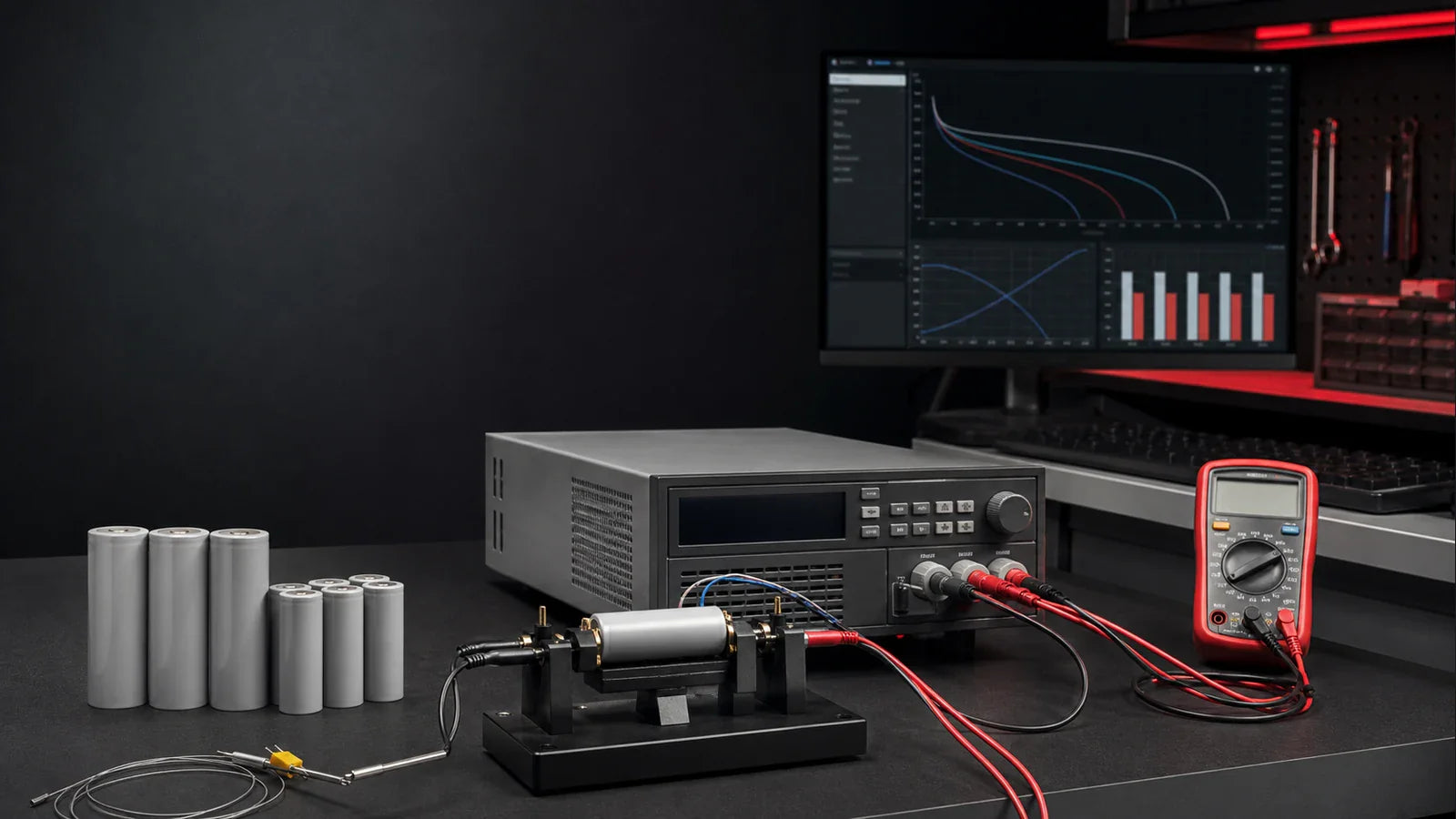
BatteryRealData is DIY500AMP's independent 18650 and 21700 cell-testing project. It turns controlled discharge logs into clear comparisons of capacity, energy, voltage sag, temperature, and performance under load so battery builders can evaluate more than the number printed on a wrapper.
Why independent battery-cell testing matters
Capacity alone does not describe a cell. Two cells with the same rated milliamp-hours can behave very differently when a pack asks for current. One may hold voltage well and remain comparatively cool; another may sag sooner, heat faster, or deliver less useful energy above the device cutoff.
That difference matters in drones, RC aircraft, power tools, e-bikes, backup systems, and every pack where current per cell, cooling, and runtime must be balanced. BatteryRealData was created to make those tradeoffs visible. It is a public project by DIY500AMP.com, created by Nelvick Berrios, with test dates, cell photos, manufacturer specifications, processed charts, and live test telemetry.
What BatteryRealData measures
During a controlled constant-current discharge, the test system records the electrical and thermal behavior of the cell over time. The public results can include:
| Metric | What it helps you understand |
|---|---|
| Voltage under load | How strongly the cell maintains voltage while working. |
| Raw capacity (mAh) | Total charge delivered to the ending point of that test. |
| Energy (Wh) | The work delivered, accounting for both voltage and capacity. |
| Temperature | How much thermal stress was observed in the test fixture. |
| Usable energy above 3.0V | A practical comparison anchor when test cutoff voltages differ. |
How BatteryRealData keeps comparisons honest
A chart is only useful when the conditions behind it are clear. BatteryRealData flags tests that stop early, identifies files that never reach the comparison cutoff, and avoids treating raw totals as a fair ranking when cutoff voltages differ. The standard methodology keeps raw measurements visible while using normalized metrics, such as usable watt-hours above 3.0V, when that creates a more meaningful comparison.
Public charts also distinguish test current, ending voltage, maximum observed temperature, and completion status. That context prevents a dramatic-looking number from hiding an early stop or a different test condition.


How a battery builder should use the results
- Start with the application. Decide whether the pack prioritizes runtime, voltage stability, compact size, low temperature rise, or a balance of those goals.
- Read the manufacturer data sheet. Confirm voltage limits, continuous-current conditions, charge limits, temperature range, and cycle-life conditions.
- Compare like with like. Select tests at the same current and review both voltage and temperature, not just final capacity.
- Design the complete pack. Current sharing, parallel count, BMS settings, conductor resistance, busbars, connections, airflow, enclosure, and aging all affect the finished system.
- Keep design headroom. A data-sheet maximum is a boundary under stated conditions, not an automatic long-term operating target.
Browse tested cells, build comparison plots, read the methodology, or watch the public live test monitor.
Browse tested cellsCompare test resultsThe safety boundary: test data is not an operating instruction
Some BatteryRealData pages include controlled stress research. Those results are observations, not new cell ratings. DIY500AMP storefront summaries intentionally show only tests performed at or below the matched manufacturer continuous-current ceiling. Pulse, burst, over-current, and other laboratory stress results remain separated on BatteryRealData and must never be used as permission to exceed the data sheet.
A monitored single-cell test fixture is also not the same environment as cells packed tightly inside an enclosure. Always follow the manufacturer documentation and use qualified protection, conductors, insulation, fusing, thermal monitoring, and pack engineering.
Frequently asked questions
Does BatteryRealData certify battery cells?
No. It is an independent testing and comparison project, not a manufacturer, safety certification laboratory, or pack-design approval service.
Can a test prove every cell from a model will perform identically?
No. A result describes the tested sample under the recorded conditions. Production variation, age, storage, temperature, equipment, and pack construction can change performance.
Where should a beginner start?
Start with the BatteryRealData cell library, then compare cells at the same current. For shopping, browse DIY500AMP's verified 18650 cells and 21700 cells.
Project references: About BatteryRealData, testing methodology and fairness rules, and laboratory safety warning.