
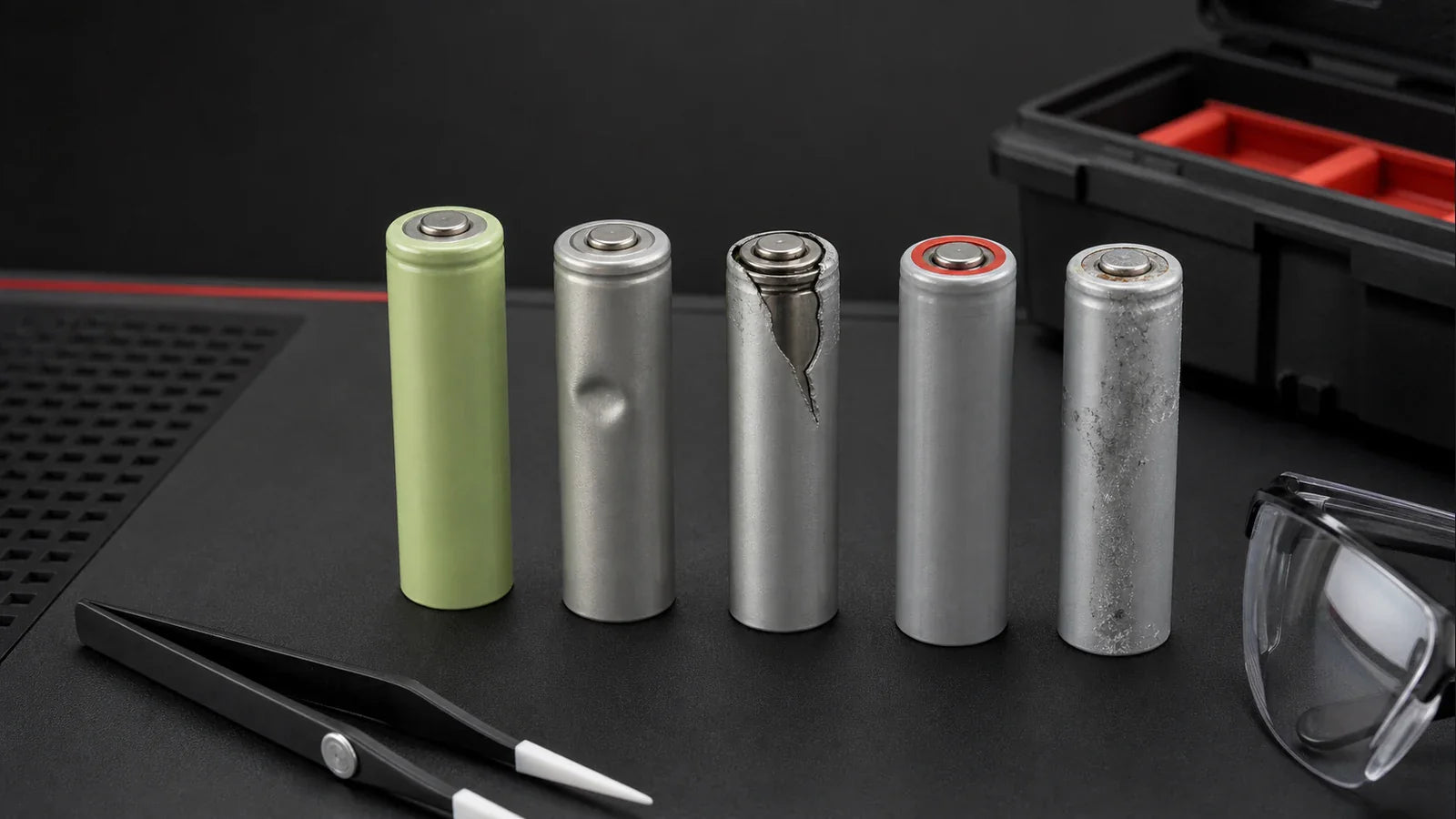
Stop using an 18650 or 21700 cell if it is dented, swollen, leaking, corroded, unusually hot, hissing, giving off an unusual odor, burned, crushed, or electrically unstable. A torn outer wrapper may be repairable only when the metal can, top insulator, and terminals are otherwise undamaged. When there is doubt, retire the cell.
Visual signs that an 18650 or 21700 cell should be retired
| Condition | Why it matters | Action |
|---|---|---|
| Dent, crease, crush, or deformation | Mechanical damage can disturb internal layers and separators. | Do not charge or reuse. |
| Swelling or raised can | Gas generation or internal failure may be present. | Treat as damaged and contact local HHW. |
| Leak, residue, corrosion, or strong odor | The seal or internal chemistry may be compromised. | Avoid contact; do not use. |
| Burn marks or heat discoloration | The cell has experienced abnormal heat or electrical stress. | Retire the cell. |
| Damaged positive terminal or missing insulator ring | The positive cap sits close to the negative metal can. Insulation damage increases short-circuit risk. | Do not use until professionally evaluated; replacement is safer. |
| Deep rust or pitting | Corrosion can weaken the can or affect terminal contact. | Retire the cell. |
A torn wrapper is not the same as a dented cell
The colored PVC sleeve is electrical insulation. Under it, nearly the entire cylindrical steel can is the negative terminal. A tear near the positive end can allow metal, a battery holder, or an adjacent cell to bridge positive to negative and create a direct short.
If the only problem is a torn wrapper, the metal can is smooth and corrosion-free, the positive terminal is normal, and the top insulator ring is present and intact, an experienced builder may replace the wrapper and insulator using the correct materials and process. A new wrapper does not repair a dent, seal damage, corrosion, heat damage, leakage, or an electrically unstable cell.


Electrical and temperature warning signs
A cell can look normal and still be unsafe or unsuitable. Stop testing and isolate the cell when you observe:
- Rapid or unexplained self-discharge after a controlled charge and rest.
- Unusual heating during charge, rest, or a modest in-spec load.
- Repeated charger faults or an inability to charge normally with a compatible charger.
- Voltage reversal, extreme imbalance, or a cell group that repeatedly falls away from the rest of a pack.
- A substantial change in capacity or internal resistance compared with its matched group, measured using the same procedure.
- Noise, hissing, odor, leakage, or temperature that continues rising after the load or charger is removed.
Do not create a universal pass/fail voltage or resistance number from an internet comment. Cell chemistry, model, state of charge, temperature, age, equipment, and manufacturer specifications all matter.
What to do after finding a damaged cell
- Stop using and charging it. Do not attempt a final discharge with improvised resistors, salt water, nails, crushing, or puncturing.
- Keep people and combustibles away. If it is hot, smoking, venting, or unstable, evacuate and call emergency services.
- Do not ship it. Damaged, defective, or recalled lithium batteries are subject to special U.S. Department of Transportation rules and cannot be treated like an ordinary parcel.
- Contact local experts. Ask your county or city household hazardous waste program how it accepts damaged lithium-ion batteries. A fire department non-emergency line can help direct you when the condition is uncertain.
- For intact end-of-life cells, insulate the terminals. Use non-conductive tape or individual plastic bags before taking them to a location that confirms it accepts loose lithium-ion cells.
Inspecting cells removed from an old battery pack
Pack removal adds risks that a loose new cell has not experienced: spot-weld scars, torn wrappers, heat history, imbalance, vibration, water intrusion, and unknown cycle count. Do not assume a reclaimed cell is safe because its voltage appears normal. Never mix reclaimed cells with new cells or combine different models, batches, capacities, ages, or states of health in one pack.
When a pack has failed, the safest path is often to diagnose the complete system professionally and replace the matched cell group or pack rather than rescuing individual unknown cells.
Browse authentic cells with manufacturer specifications and practical selection guidance. Never mix a replacement cell into a pack without confirming compatibility, matching, and pack condition.
Shop 18650 cellsShop 21700 cellsFrequently asked questions
Can I use a dented cell if it still measures normal voltage?
No. Voltage does not reveal whether mechanical damage has compromised internal separators or created a delayed failure risk.
Is a small nick in the wrapper dangerous?
Any exposed metal can create a short-circuit path. Stop using the cell until the entire wrapper and top insulator are correctly restored. If the can or terminal is damaged, retire the cell.
Can I put a damaged cell in a retail recycling bin?
Not unless that facility explicitly accepts damaged lithium-ion cells. Contact local household hazardous waste staff for instructions. Do not place a hot, swollen, leaking, crushed, or burned cell in a standard collection box.
Safety references: U.S. EPA lithium-ion battery guidance, PHMSA lithium battery transport guidance, and CPSC loose-cell safety warning.