
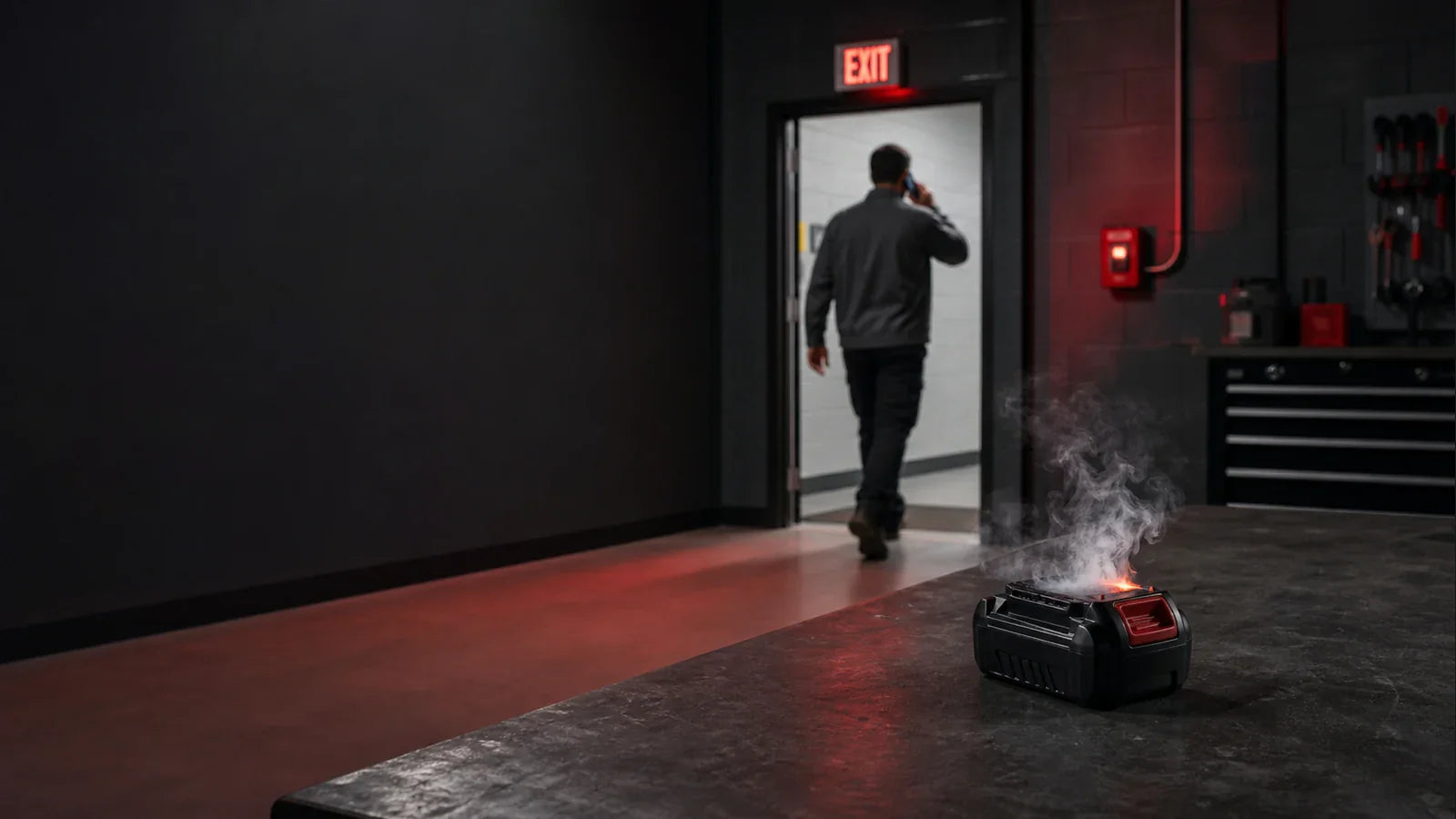
If a lithium-ion cell or battery is hissing, venting, smoking, rapidly heating, or burning, move away, warn others, evacuate, close the door if it is safe to do so, and call 911. Do not inhale the smoke, touch the battery, carry it through the building, or place it in a vehicle.
Recognize lithium-ion battery failure early
Thermal runaway can begin with warning signs before open flame appears. Treat any of the following as a reason to stop charging or operation and move people away:
- A cell or pack becoming unusually hot or continuing to heat after the load is removed.
- Swelling, deformation, popping, crackling, or hissing.
- Sweet, solvent-like, metallic, or otherwise unusual chemical odor.
- Vapor, mist, smoke, sparks, or hot particles.
- Rapid voltage instability, charger faults, or repeated protection trips combined with heat.
- Burn marks, melted insulation, damaged conductors, or one cell heating more than its neighbors.
Do not lean over a failing cell to inspect it. A cylindrical cell can vent hot gas and material from its safety vent, rupture, or propel itself if pressure rises.
What to do immediately
- Alert everyone nearby. Do not let another person unknowingly enter the area.
- Evacuate and call 911. Give the dispatcher the location, battery type if known, whether anyone is injured, and whether the fire involves a vehicle, building, charger, or large pack.
- Close doors behind you if safe. This can slow smoke and fire spread. Do not lock responders out or delay your exit.
- Avoid smoke and fumes. Move upwind outdoors and do not re-enter for property, tools, or the battery.
- Tell firefighters about possible batteries. Identify the chemistry, pack voltage, location, number of cells, charger, and any nearby battery inventory if you can do so from a safe place.


Water, extinguishers, and a common lithium-ion misconception
Rechargeable lithium-ion cells contain lithium compounds, not exposed bulk lithium metal. The National Fire Protection Association notes that water is suitable for lithium-ion battery fires because cooling is critical. This is different from a lithium-metal fire, for which specialized Class D considerations may apply.
That distinction does not mean an untrained person should remain beside a failing pack with a hose. Firefighters may need substantial water and continued cooling, while also managing electrical hazards, toxic smoke, runoff, nearby cells, and the possibility of reignition. A portable ABC extinguisher may knock down flames in nearby ordinary combustibles, but it may not cool cells enough to stop thermal runaway inside a pack.
Do not pick up, kick, cover, crush, puncture, or carry a smoking battery. Do not place it in a sealed pressure-tight container. Do not use salt water or improvised chemicals. Do not assume that the absence of visible flame means the battery is stable.
Why a lithium-ion battery can reignite
Heat can remain trapped inside a cell or pack after visible flames stop. Adjacent cells may be damaged without having failed yet, and a pack can return to thermal runaway minutes or hours later. Firefighters may monitor temperature and continue cooling long after the first knockdown.
Do not re-enter the area or move the battery until the fire department says it is safe. Damaged fire-involved cells and packs require specialized handling and transport. They should not go into household trash, curbside recycling, a normal retail battery bin, or an ordinary mail shipment.
How to reduce lithium-ion battery fire risk
- Use authentic cells and the exact manufacturer data sheet.
- Do not exceed voltage, current, charge, discharge, or temperature limits.
- Use a correctly engineered BMS, fusing, insulation, conductors, enclosure, and thermal monitoring.
- Never carry loose cells with metal objects or use a cell with a damaged wrapper, insulator, terminal, or can.
- Use only a compatible charger and never leave charging batteries unattended.
- Keep charging and storage away from exits and combustible material.
- Stop using a battery after impact, crushing, water intrusion, abnormal heat, swelling, odor, or repeated electrical faults.
- Have a written emergency plan that includes evacuation routes, 911, battery inventory information, and how responders will access the area.
Read DIY500AMP's permanent battery warning and recycling instructions before purchasing, handling, building, or transporting loose lithium-ion cells.
Battery safety warning Recycling and disposalFrequently asked questions
Should I use a Class D extinguisher on a lithium-ion battery?
Class D extinguishing agents are associated with combustible-metal fires, including lithium metal. Ordinary rechargeable lithium-ion cells are a different chemistry. Fire-department and NFPA guidance emphasizes cooling for lithium-ion. Follow local emergency guidance and do not delay evacuation while choosing equipment.
Is the smoke dangerous?
Yes. Battery fire and vent gases can be toxic, irritating, hot, and flammable. Avoid inhalation, leave the area, and tell emergency responders about anyone who may have been exposed.
Can I reuse cells from a pack that had a fire?
No. Heat and fire exposure can create hidden damage and delayed failure. The pack should be evaluated and handled through professional fire-damage and hazardous-waste channels.
Emergency and safety references: NFPA lithium-ion battery safety, NFPA energy storage system safety, EPA lithium-ion guidance, and PHMSA transport guidance. In an emergency, call 911.