
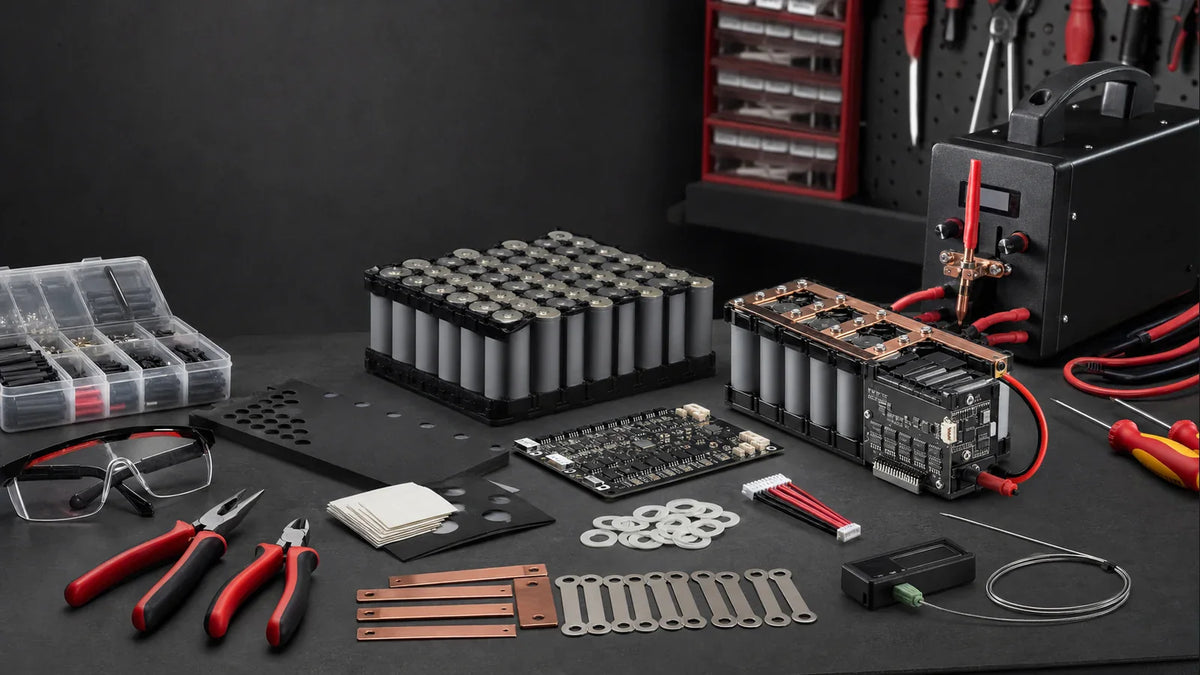
Safe lithium-ion pack building begins before the first weld. Use authentic matched cells, follow the manufacturer data sheet, design the pack and protection system as one engineered assembly, prevent short circuits, control heat, inspect every component, and plan how the pack will be charged, transported, serviced, and retired.
1. Select the cell for the real pack load
Begin with current per cell, required energy, voltage under load, temperature, duty cycle, enclosure, expected cycle life, and charging time. A high-capacity cell is not automatically a high-current cell, and a high-current cell is not automatically the best choice for a long-runtime application.
Use the manufacturer data sheet as the operating boundary. Maximum ratings apply only under the stated conditions and should not be treated as an automatic continuous design target. Build in headroom and validate the finished pack under its actual load and cooling conditions.
Cells in one pack should be matched by exact model, production batch when possible, age, prior use, state of charge, capacity, and internal resistance. Do not mix new cells with used cells, different manufacturers, different model numbers, or unknown reclaimed inventory.


2. Treat short-circuit prevention as a primary safety system
On a cylindrical cell, the positive terminal is isolated at the top while most of the metal can is negative. A misplaced nickel strip, sharp busbar edge, damaged wrapper, dropped tool, or missing top insulator can bridge the terminals and release very high current.
- Inspect every wrapper, top insulator, terminal, and metal can before assembly.
- Use correctly fitted cell-level insulation, barriers, holders, fish paper, and edge protection.
- Cover exposed conductors as the build progresses instead of waiting until the end.
- Use insulated tools and remove jewelry, watches, loose hardware, and conductive debris from the work area.
- Plan conductor routing so vibration, compression, abrasion, and enclosure movement cannot create a future short.
3. Coordinate the BMS, fusing, charger, and thermal design
A BMS is essential in many pack designs, but it is not magic. It must be compatible with the series count, chemistry, charge voltage, current, balance strategy, temperature sensors, contactors or MOSFETs, and failure modes of the complete system. Protection thresholds must remain within the cell data sheet and the limits of every conductor and component.
Pack-level and, where appropriate, cell-group fusing should be engineered to interrupt a fault before conductors, interconnects, connectors, or cells reach dangerous conditions. Thermal sensors must be located where they can detect the conditions that matter. Airflow or a cool bench test cannot be assumed to represent cells buried inside a finished enclosure.
| Protection layer | What it must address | Common mistake |
|---|---|---|
| BMS | Overcharge, over-discharge, over-current, short circuit, balancing, and temperature as required. | Selecting only by advertised amperage. |
| Fuse system | Available fault current, wire and busbar limits, pack segmentation, and service faults. | Assuming the BMS replaces all fusing. |
| Thermal design | Cell heat, conductor heat, ambient temperature, enclosure, and heat propagation. | Measuring only the easiest outside surface. |
| Charger | Correct chemistry, series voltage, current, termination, temperature, and communication. | Using a supply as though it were a qualified charger. |
4. Size and assemble every current path correctly
Current does not stop at the cell. Nickel, copper, busbars, welds, wire, connectors, switches, BMS conductors, and terminals must all carry the expected current with acceptable voltage drop and temperature rise. Current sharing can become uneven when parallel connections have different resistance or geometry.
Do not solder directly to cylindrical cell terminals. Prolonged heat can damage seals and internal components. Use a properly configured spot-welding process, qualified interconnect material, verified weld energy, and destructive coupon testing before production assembly. Confirm weld quality without puncturing, overheating, or deforming the cell.
5. Make first power-up and charging controlled events
- Verify polarity, series count, balance leads, insulation, clearances, connector pinout, fuse placement, and BMS configuration before connecting power.
- Measure group voltages with insulated probes and compare them before enabling the pack.
- Use current-limited, protected equipment and a written first-power-up procedure.
- Monitor cell-group voltage and temperature during the first charge and discharge cycles.
- Charge on a fire-resistant surface away from combustibles and never leave charging unattended.
- Stop immediately for unusual heat, odor, hissing, swelling, imbalance, or unstable voltage.
A successful first cycle does not prove long-term safety. Validate the pack at realistic ambient temperature, duty cycle, vibration, enclosure, and aging conditions before relying on it.
6. Plan the entire battery life cycle
Define how the pack will be inspected, stored, charged, transported, serviced, and retired. Keep documentation for cell model, batch, pack configuration, protection settings, connector pinout, charger, and inspection history. A user should never have to guess which charger or voltage belongs to the pack.
For storage, isolate exposed terminals and follow the manufacturer's temperature and state-of-charge guidance. For transportation, comply with PHMSA and carrier requirements. For end of life, never place lithium-ion cells in household trash or curbside recycling.
Frequently asked questions
Is a BMS enough to make a battery pack safe?
No. A BMS is one protection layer. Cell selection, insulation, fusing, conductors, welds, enclosure, thermal design, charger compatibility, software settings, workmanship, and validation all matter.
Can I use the manufacturer maximum current as my normal pack target?
Not automatically. A maximum rating is a boundary under stated conditions. Keep engineering headroom and validate temperature, voltage sag, current sharing, BMS limits, and conductor temperature in the complete pack.
Can I carry spare cells loose?
No. Use a protective case or individually insulated packaging. Keys, coins, tools, and other cells can create a direct short.
Safety references: CPSC loose-cell warning, PHMSA lithium battery transportation guidance, and UL Solutions guidance on lithium-ion fire risks.