
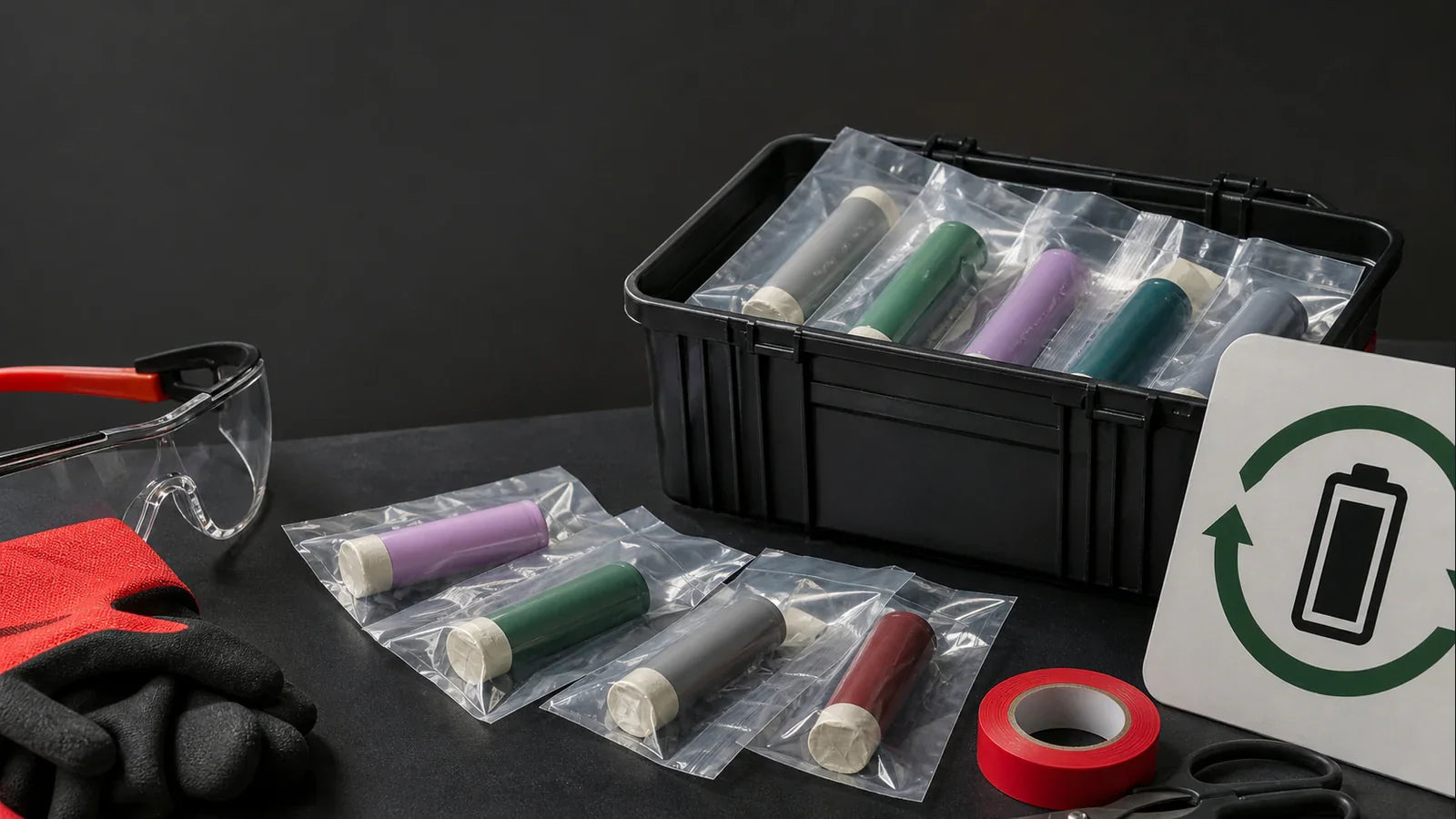
Never put loose 18650, 21700, or other lithium-ion cells in household trash or curbside recycling. For intact end-of-life cells, protect the terminals with non-conductive tape or place each cell in its own plastic bag, then use a battery recycler or household hazardous waste location that confirms it accepts loose lithium-ion cells.
Why lithium-ion cells do not belong in household bins
A "dead" cell can still retain enough energy to short against metal. Trash and recycling systems compact, crush, sort, and transport mixed materials. A loose battery that contacts another battery, a tool, foil, or machinery can heat, spark, ignite, or start a fire in a truck or processing facility.
The U.S. Environmental Protection Agency says lithium-ion batteries should not go in household garbage or municipal recycling bins. Most discarded lithium-ion batteries are likely to meet hazardous-waste characteristics because they can be ignitable or reactive.
How to prepare an intact 18650 or 21700 cell for recycling
- Inspect it without charging. If it is hot, swollen, leaking, crushed, corroded, burned, dented, or giving off an odor, stop and use the damaged-cell instructions below.
- Protect the terminals. Cover the positive and negative ends with secure non-conductive tape, or place each cell in its own clear plastic bag. The goal is to prevent any conductive contact.
- Use a non-conductive container. Keep prepared cells separated from keys, coins, tools, wire, copper, nickel strip, and other batteries.
- Label the container. Identify it as lithium-ion batteries for recycling so household members do not mistake it for usable inventory or ordinary trash.
- Confirm acceptance before traveling. Not every retail bin accepts loose cylindrical cells, large quantities, or damaged batteries.


Where to recycle 18650 and 21700 batteries
| Option | Best use | Confirm first |
|---|---|---|
| Household hazardous waste | Loose cells, larger quantities, and situations needing local guidance. | Hours, appointment rules, quantity limits, and damaged-cell procedure. |
| Battery recycling drop-off | Prepared, intact rechargeable cells. | That the specific location accepts loose lithium-ion cylinders. |
| Electronics recycler | Battery packs, devices with installed batteries, and some removable cells. | Battery type, device condition, fees, and drop-off requirements. |
| Participating retailer | Small quantities of intact rechargeable batteries. | Whether bare cells are accepted and how terminals must be prepared. |
Use The Battery Network locator to find nearby options, then call or check the facility website before you go. Local rules can change, and a location that accepts a laptop battery may not accept loose 18650 cells.
What to do with a damaged, defective, or recalled battery
Damaged, defective, and recalled batteries present a higher risk of heat, fire, and short circuit. Keep people away, do not charge the battery, and do not place it in a normal store collection box. Contact your local household hazardous waste facility or local fire department non-emergency line for condition-specific guidance.
If there is immediate evidence of failure, including smoke, hissing, venting, flames, or rapidly spreading heat, leave the area and call emergency services. Do not carry a failing cell through an occupied building or place it in a vehicle.
Do not improvise shipping for old or damaged cells
Lithium batteries are regulated hazardous materials in transportation. U.S. Department of Transportation requirements cover terminal protection, packaging, marking, documentation, and the special handling of damaged or defective batteries. Damaged cells that are likely to produce dangerous heat, fire, or short circuits have stricter rules and are forbidden from air transport.
DIY500AMP does not operate a public mail-back recycling program. Local drop-off or household hazardous waste guidance is normally the safest route for customers.
Confirm acceptance with the facility, especially for loose cylindrical cells, large quantities, or any damaged battery.
Find a drop-off DIY500AMP recycling guideFrequently asked questions
Should I discharge a cell completely before recycling?
Do not use improvised methods such as salt water, puncturing, crushing, shorting, or unattended resistors. Follow the receiving facility's instructions. Terminal protection and a confirmed recycling route are more important than attempting a risky "zero-volt" process.
Can I tape several cells together?
Each cell should be protected from contact with other cells and conductive material. Tape each terminal or individually bag each cell, then use a non-conductive outer container.
Can I throw away a battery that no longer charges?
No. A cell that will not run a device may still short or ignite when crushed. Recycle it through a qualified program.
Authoritative references: EPA lithium-ion battery FAQ, EPA recycling FAQ, and PHMSA lithium battery transportation guidance.