
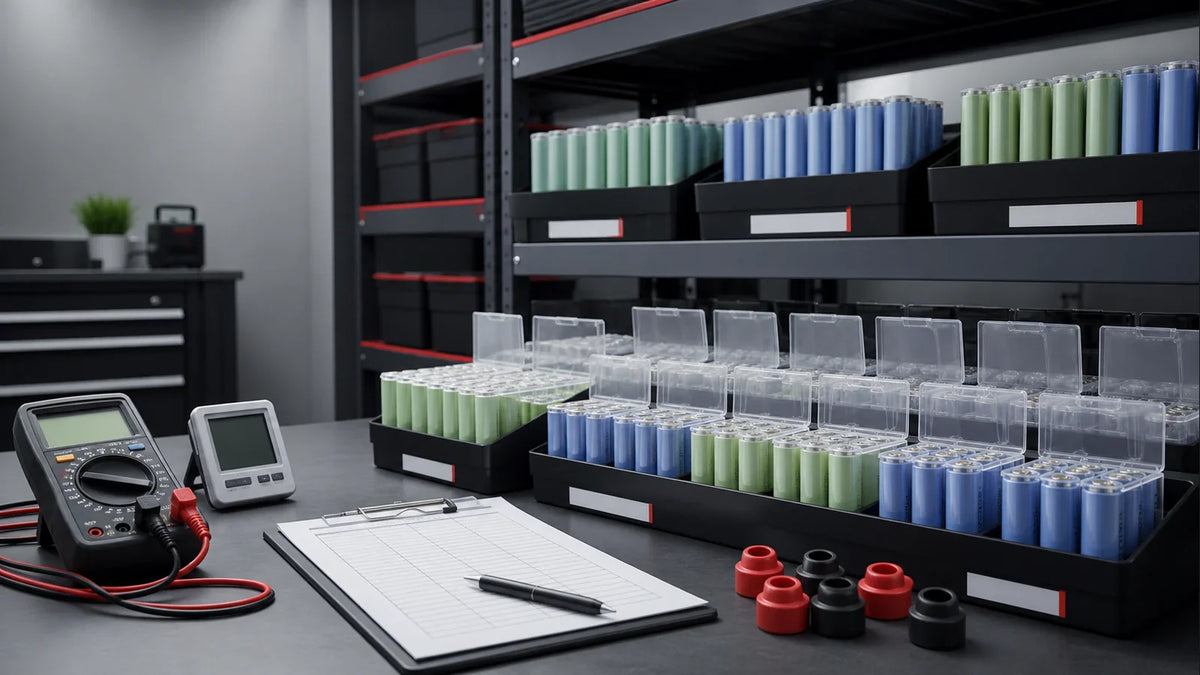
Store 18650 and 21700 cells in a cool, dry, temperature-stable location with their terminals isolated and their identity preserved. For long-term storage, follow the manufacturer's recommended storage voltage or state of charge, inspect cells periodically, and keep different models, batches, ages, and conditions separated.
Best storage conditions for cylindrical lithium-ion cells
Heat accelerates lithium-ion aging and can increase risk. Moisture can corrode terminals, damage wrappers, and create conductive contamination. A stable indoor room-temperature environment is usually better than a garage, vehicle, attic, shed, window ledge, or outdoor storage area.
| Do | Avoid |
|---|---|
| Use individual cell cases, insulating trays, or non-conductive dividers. | Loose cells in drawers, bags, pockets, or toolboxes. |
| Choose a cool, dry, ventilated area away from combustibles. | Direct sun, heaters, vehicles, hot garages, damp basements, and water sources. |
| Keep cells upright or secured so they cannot roll, fall, or collide. | Tall unstable stacks or heavy items placed on top. |
| Store away from children, pets, conductive material, and ignition sources. | Keys, coins, screws, wire, nickel strip, copper strip, or exposed busbars. |
Refrigeration is generally unnecessary for normal users and can create condensation when cold cells return to a warmer, humid environment. Follow the manufacturer data sheet when a cell or pack has special storage requirements.
What state of charge is best for storage?
Keeping a lithium-ion cell at full charge for long periods generally increases aging stress, while allowing it to self-discharge too far can make recovery unsafe or impossible. Many manufacturers specify long-term storage around a partial state of charge, often near the shipping condition, but the correct voltage window is model-specific.
Use the cell data sheet as the authority. If no storage voltage is published, avoid leaving cells fully charged for months and check them often enough that they do not fall below the manufacturer's allowed voltage range. Never use a charger or improvised method that is incompatible with the cell chemistry and voltage.


Keep cell identity and batch history intact
Organization is a safety control, not just housekeeping. Label storage trays or cases with:
- Manufacturer and exact model number.
- Supplier, purchase date, and lot or batch information when available.
- New, tested, used, reclaimed, quarantined, or end-of-life status.
- Measured resting voltage and test date when relevant.
- Pack assignment or matched group so cells are not accidentally mixed.
Do not combine cells merely because they share the same diameter. An 18650 or 21700 designation describes the approximate physical format, not the chemistry, voltage limits, capacity, current rating, age, or condition.
A practical periodic inspection routine
- Inspect the storage area. Check for water, heat, direct sunlight, damaged containers, conductive debris, or signs of impact.
- Inspect every cell visually. Look for torn wrappers, missing insulator rings, dents, corrosion, leakage, swelling, burn marks, or discoloration.
- Check for unexpected heat or odor. A resting cell should not be warm or emit a chemical smell.
- Measure resting voltage when appropriate. Use insulated tools and a consistent procedure. Investigate a cell that drifts differently from its matched group.
- Update records. Mark any cell removed from service and keep it physically separated from usable inventory.
Inspection frequency depends on the cell, age, storage state, and environment. Cells stored for months need a planned review schedule. Never assume that "out of sight" means stable.
Returning stored cells to service
Before building or charging, let cells that experienced a temperature change return to room temperature in a dry environment. Inspect them again, verify their identity, and confirm resting voltage. Use a compatible charger with independent monitoring and follow the manufacturer's charge current, voltage, and temperature limits.
For a multi-cell pack, match cells by model, batch, age, condition, capacity, internal resistance, and state of charge using a qualified process. Do not mix a new cell into an aged group simply because its dimensions fit.
DIY500AMP product pages pair manufacturer specifications with plain-language fit guidance and, when available, BatteryRealData tests within data-sheet parameters.
Browse 18650 cells Browse 21700 cellsFrequently asked questions
Should lithium-ion cells be stored fully charged?
Not for routine long-term storage unless the manufacturer specifically requires it. Follow the model's storage specification and avoid both prolonged full charge and excessive self-discharge.
Can I store cells in a metal ammunition box?
A metal enclosure can create short-circuit and pressure hazards if it is used without proper non-conductive separation, venting strategy, and engineering. Do not place loose cells against conductive walls or seal an unstable battery in a pressure-tight container. Use purpose-designed storage and local fire-safety guidance.
What if a stored cell is swollen, hot, leaking, or damaged?
Do not charge or reuse it. Read how to identify a damaged cell and follow local household hazardous waste instructions. If it is smoking, venting, or burning, evacuate and call 911.
Safety reference: U.S. EPA frequently asked questions on lithium-ion batteries. Always follow the exact manufacturer data sheet for cell-specific storage limits.